
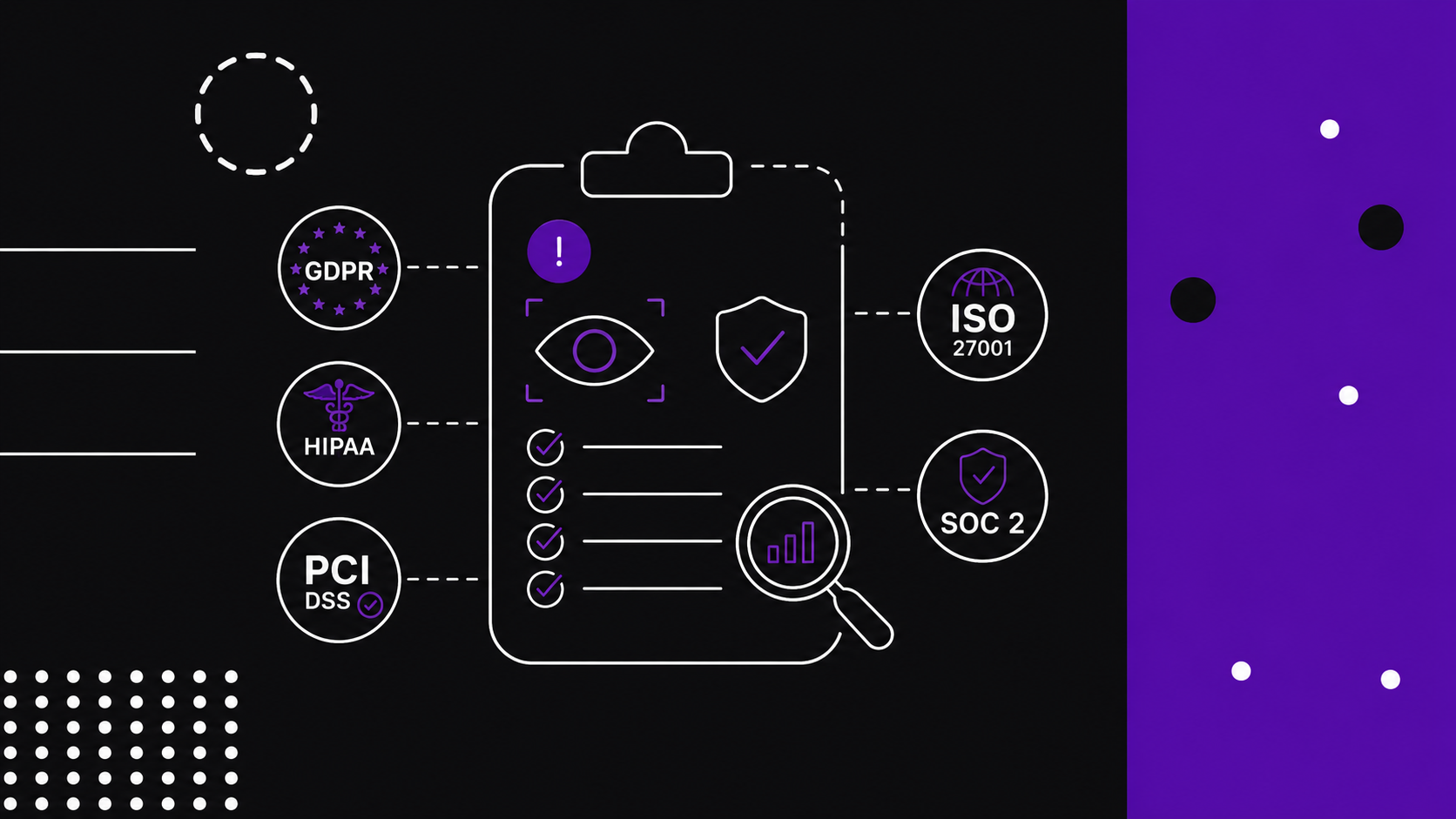
The Compliance Case for Breach Monitoring
Data breach monitoring has moved from a “nice to have” security practice into a core evidence layer for modern compliance. The term can mean several things: monitoring exposed credentials, leaked databases, ransomware leak sites, paste sites, criminal marketplaces, open web sources, forums, code repositories, and other places where compromised corporate or customer data may surface. Compliance teams often describe this capability through broader terms such as threat intelligence, security monitoring, data leakage prevention, incident detection, compromised credential detection, and breach response readiness.
The important point is that most standards focus on outcomes rather than one specific tool. They expect organizations to detect threats, monitor for security events, identify unauthorized exposure of data, respond to incidents, and notify regulators or affected parties when required. Data breach monitoring supports all of those outcomes because it gives the organization visibility outside its own perimeter, where stolen credentials, sensitive records, customer data, source code, and internal documents may appear before the organization detects the breach internally.
ISO 27001 and ISO 27002: Breach Monitoring as Threat Intelligence and Leakage Detection
ISO/IEC 27001 is one of the strongest standards for justifying breach monitoring because it requires organizations to operate an information security management system based on risk. ISO describes ISO/IEC 27001 as a standard for establishing, implementing, maintaining, and continually improving an ISMS, with a focus on managing risks related to the security of data owned or handled by the organization.
In practice, data breach monitoring connects directly to several ISO 27002:2022 control areas. The most relevant are threat intelligence, data leakage prevention, logging, and monitoring activities. Threat intelligence requires organizations to understand relevant threats and use that knowledge to reduce risk. Data leakage prevention requires controls that reduce the chance of sensitive information leaving the organization in unauthorized ways. Monitoring activities and logging help detect suspicious behavior and support investigations.
A mature ISO 27001 program can treat breach monitoring as an external detection layer. Internal controls show what happens inside the organization. Breach monitoring shows what may have already escaped, what credentials attackers may be using, and which exposed assets create immediate business risk. This makes breach monitoring especially valuable for companies handling customer data, regulated data, intellectual property, or credentials that provide access to production systems.
SOC 2: Breach Monitoring as Evidence for Security and Privacy Controls
SOC 2 is another strong compliance driver. The AICPA Trust Services Criteria include criteria for security, availability, processing integrity, confidentiality, and privacy. In a SOC 2 context, breach monitoring can support controls around vulnerability detection, anomaly monitoring, incident response, unauthorized disclosure, and privacy breach handling.
For security-scoped SOC 2 reports, breach monitoring helps demonstrate that the company actively monitors for indicators of compromise and unauthorized exposure. For privacy-scoped SOC 2 reports, it becomes even more relevant because privacy programs need ways to detect, document, investigate, and respond to suspected unauthorized disclosure of personal information. A company that monitors only internal logs may miss evidence that personal data has already surfaced externally. External breach monitoring fills that gap.
This is why breach monitoring can be especially useful in SOC 2 audits for SaaS companies, data providers, fintech companies, cybersecurity vendors, and platforms that process large volumes of customer information. It creates auditable evidence that the organization has a process for identifying compromised data beyond the systems it directly controls.
PCI DSS: Breach Monitoring Around Payment Data and Account Compromise
PCI DSS v4.0.1 applies to organizations that store, process, or transmit payment card data. The standard is built around technical and operational requirements for protecting payment account data. The PCI Security Standards Council’s document library identifies PCI DSS v4.0.1 as the current PCI DSS standard, with supporting materials published around implementation and prioritization.
Breach monitoring supports PCI DSS through several practical use cases. It can identify exposed payment card data, compromised merchant credentials, leaked admin access, vulnerable payment assets, and criminal chatter about a merchant or service provider. PCI also places heavy emphasis on logging, security monitoring, incident response, and protection of cardholder data. External breach intelligence helps teams detect signs of compromise that may appear outside the cardholder data environment.
For payment companies, breach monitoring is useful because attackers frequently monetize card data and payment credentials in external channels. Monitoring those channels gives compliance and security teams another source of evidence for incident triage, fraud investigation, and response readiness.
GDPR: Breach Monitoring and the 72-Hour Notification Clock
The GDPR creates one of the clearest business reasons to invest in breach detection. Article 33 requires controllers to notify the supervisory authority after becoming aware of a personal data breach, where feasible within 72 hours.
That requirement makes awareness the critical trigger. Organizations need reliable ways to discover personal data breaches quickly, investigate them, assess risk, and decide whether notification is required. Data breach monitoring helps create earlier awareness by detecting exposed personal information, leaked customer databases, credential dumps, or public references to stolen data.
Article 32 also matters because it requires appropriate security measures for personal data processing, including confidentiality, integrity, availability, resilience, and regular evaluation of security measures. Breach monitoring can support that requirement by giving the organization continuous feedback about whether personal data, credentials, or sensitive business information has appeared outside authorized environments.
For GDPR programs, breach monitoring should be positioned as a detection and response accelerator. It helps organizations shorten the time between external exposure and internal awareness, which directly supports regulatory decision-making and incident documentation.
NIST CSF and NIST 800-53: Continuous Monitoring and Indicators of Compromise
The NIST Cybersecurity Framework 2.0 is designed to help organizations of all sizes and sectors manage and reduce cybersecurity risks. Its Detect function is especially relevant to breach monitoring because it focuses on finding anomalies, adverse events, and signs of compromise.
NIST SP 800-53 Rev. 5 provides a detailed catalog of security and privacy controls for information systems and organizations. NIST describes the publication as a catalog intended to protect organizational operations, assets, individuals, other organizations, and national interests from threats such as hostile attacks, human error, disasters, structural failures, foreign intelligence activity, and privacy risks.
Within NIST 800-53, the SI-4 System Monitoring control is highly relevant. It focuses on monitoring systems to detect attacks, indicators of potential attacks, unauthorized connections, unauthorized use, detected anomalies, and changes in risk. Breach monitoring strengthens this control by adding external signals. A leaked password, exposed API key, stolen session cookie, dumped database, or mention of the company on a criminal forum can serve as an indicator of potential attack activity.
For organizations aligned with NIST, breach monitoring should be treated as part of a broader continuous monitoring strategy. It complements SIEM logs, endpoint telemetry, identity alerts, vulnerability scanning, and incident response workflows.
NIST 800-171 and CMMC: External Signals for Defense Contractors
NIST 800-171 and CMMC are particularly relevant for organizations that handle controlled unclassified information for the U.S. defense ecosystem. These frameworks emphasize safeguarding sensitive information, monitoring systems, detecting attacks, and responding to security incidents.
Data breach monitoring can support these requirements by identifying exposed credentials, leaked controlled information, references to contractor networks, compromised supplier accounts, and other external indicators that sensitive information may be at risk. For contractors with distributed suppliers, remote users, and cloud services, external breach monitoring gives security teams a broader view of exposure across the ecosystem.
The value here is practical as well as regulatory. If a defense contractor discovers its employee credentials in a breach dump, that discovery can trigger password resets, identity investigation, access review, and incident documentation before attackers use those credentials against protected environments.
DORA: Breach Monitoring for Financial Sector Resilience
The EU Digital Operational Resilience Act, known as DORA, entered into application on January 17, 2025. EIOPA describes DORA as a regulation designed to strengthen the digital resilience of financial entities and ensure that banks, insurers, investment firms, and other financial organizations can withstand, respond to, and recover from ICT disruptions such as cyberattacks or system failures.
DORA is highly relevant to breach monitoring because financial entities need strong ICT risk management, incident detection, incident classification, third-party risk awareness, and cyber threat reporting processes. Breach monitoring can help identify compromised employee credentials, leaked customer data, exposed vendor access, mentions of financial institutions on criminal marketplaces, and ransomware-related disclosures.
For financial institutions, external monitoring also supports operational resilience. A leaked credential is more than an identity issue. It can become the starting point for fraud, account takeover, business email compromise, vendor compromise, or systemic operational disruption. DORA pushes firms to understand and manage this risk with stronger discipline.
NIS2: Breach Monitoring for Essential and Important Entities
The EU NIS2 Directive strengthens cybersecurity obligations for essential and important entities across sectors such as energy, transport, banking, healthcare, digital infrastructure, public administration, managed services, and online platforms. The directive aims to harmonize cybersecurity risk-management measures and reporting obligations across relevant entities.
Article 21 requires appropriate and proportionate technical, operational, and organizational measures to manage risks to network and information systems and to prevent or minimize the impact of incidents. A practical breach monitoring program supports those goals by helping organizations detect exposed data, compromised accounts, supplier-related leaks, and early signs of attack planning.
NIS2 also increases the importance of supply-chain visibility. Breach monitoring can reveal incidents affecting suppliers, service providers, domains, credentials, code repositories, and exposed infrastructure connected to the organization’s risk environment. That makes it valuable for both internal security and vendor risk management.
HIPAA: Breach Monitoring for Healthcare Data Protection
HIPAA security and breach obligations create a strong rationale for breach monitoring in healthcare. The HIPAA Security Rule requires covered entities and business associates to implement safeguards that protect electronic protected health information. The technical safeguard provisions include audit controls, access controls, integrity controls, person or entity authentication, and transmission security.
Healthcare data is valuable because it combines identity information, insurance details, clinical information, payment data, and long-lived personal records. External breach monitoring can detect exposed patient files, leaked healthcare credentials, compromised vendor access, or references to healthcare organizations on ransomware leak sites.
For HIPAA-covered organizations and their vendors, breach monitoring works best as part of a broader security program that includes identity protection, audit logging, endpoint monitoring, vendor risk management, and incident response. It helps teams identify exposure faster and document the steps taken to investigate and contain possible breaches.
CIS Controls: Breach Monitoring as a Practical Security Baseline
The CIS Controls are widely used as a practical cybersecurity baseline. They help organizations prioritize safeguards such as asset management, account management, vulnerability management, audit log management, malware defenses, data protection, and incident response.
Breach monitoring supports CIS-aligned programs by strengthening visibility across accounts, data, and external exposure. When credentials appear in breach repositories, teams can force resets, revoke sessions, review privileged access, and look for evidence of account misuse. When sensitive files appear online, teams can initiate incident handling and data protection workflows. When company domains or executives appear in criminal discussions, teams can improve phishing defense and executive protection.
CIS is especially useful for translating breach monitoring into day-to-day security operations. It shifts the discussion from abstract compliance to operational questions: which accounts are exposed, which systems can those accounts reach, which data appeared externally, which response action is required, and which control failed.
The Right Way to Position Breach Monitoring in Compliance
The strongest compliance position is precise and outcome-based. Data breach monitoring should be described as a control that supports threat intelligence, data leakage prevention, continuous monitoring, incident detection, credential compromise response, and breach notification readiness. That framing aligns well with ISO 27001, SOC 2, PCI DSS, GDPR, NIST, DORA, NIS2, HIPAA, and CIS Controls.
The most persuasive argument is that modern breaches often surface externally before they are fully understood internally. Attackers trade credentials, publish stolen files, advertise access, discuss targets, and leak data across open and closed sources. A company that monitors only its own systems sees part of the picture. A company that also monitors external breach signals gains earlier warning, better context, and stronger evidence for compliance.
For auditors, regulators, and customers, breach monitoring shows that the organization treats detection as a continuous responsibility. It demonstrates that security teams look beyond internal logs, identify real-world exposure, and connect external intelligence to response workflows. For business leaders, it reduces blind spots around customer trust, regulatory timing, and reputational harm.
Conclusion
Data breach monitoring is becoming a standard part of serious compliance and security programs. The requirement usually appears through broader obligations rather than a single phrase. ISO 27001 points to risk management, threat intelligence, leakage prevention, and monitoring. SOC 2 focuses on detection, anomalies, unauthorized disclosure, and privacy response. PCI DSS emphasizes protection and monitoring of payment data. GDPR creates urgency through breach awareness and the 72-hour notification timeline. NIST, DORA, NIS2, HIPAA, and CIS all reinforce the same direction: organizations need reliable ways to detect compromise, understand exposure, and respond quickly.
The practical takeaway is clear. Data breach monitoring is best viewed as an external detection control that strengthens compliance evidence and reduces real operational risk. It helps organizations answer the question that every regulator, auditor, customer, and board eventually asks after an incident: how quickly did you know, what did you know, and what did you do next?


 Previous post