
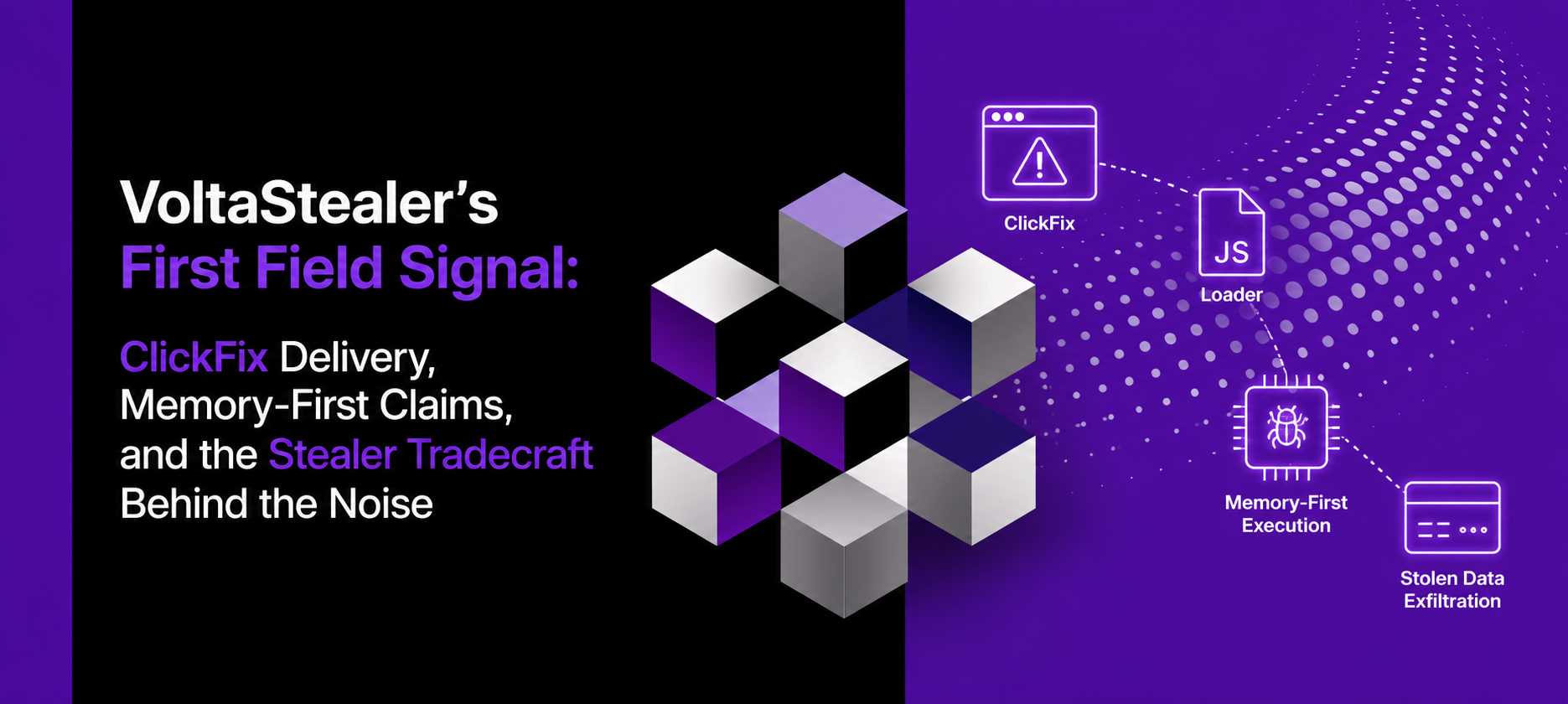
When VoltaStealer first appeared in underground markets, the most important detail was not the branding. It was the architecture the author claimed to be selling. VoltaStealer was advertised as a fast, in-memory, evasion-heavy infostealer with modular collection, chunked exfiltration, anti-analysis logic, and a full Malware-as-a-Service operating layer. At the time, the story was mostly about intent: a new stealer builder trying to compete in a crowded ecosystem by promising lower detection, broader collection, and better operational tooling.
Infoblox’s latest finding changes the status of the threat. While tracking a ClickFix actor, researchers pivoted from a known IOC into an open directory containing payloads and artifacts they believe point to VoltaStealer. That makes this more than a dark web sales pitch. It creates the first known field signal that defenders can hunt, reverse, enrich, and connect to real infrastructure.
The technical story is not only “VoltaStealer may now be in the wild.” The more important story is how it appears to have reached the victim: through ClickFix, a social engineering execution chain that turns a fake verification page into user-assisted PowerShell execution. That delivery model pairs naturally with modern stealers. It gives attackers code execution without an exploit, while the malware focuses on rapid collection of browser secrets, authentication material, wallets, messaging sessions, VPN artifacts, local files, and other high-value data.
From Forum Claims to a Huntable Artifact
The original VoltaStealer pitch made several aggressive technical claims. The malware was advertised as running fully in memory, using custom encryption and obfuscation, minimizing disk artifacts, avoiding virtual machines and sandboxes, resisting debuggers, using direct syscalls, generating partially unique builds, and exfiltrating data in chunks to reduce detection. It also claimed short execution time, no persistence requirement, partial upload if interrupted, and broad support for credential, session, wallet, Telegram, VPN, and file collection.
Those claims should still be treated as claims until validated through sample analysis. Malware authors routinely exaggerate “FUD,” hit rate, uniqueness, and bypass capability. The significance of the Infoblox finding is that researchers now have a possible sample path. A real payload allows defenders to test the builder’s output, inspect strings and configuration, identify packer or loader behavior, map imported APIs or dynamic resolution, observe process behavior, extract C2 logic, and compare actual collection modules against the underground sales material.
This matters because stealers evolve quickly. The first sample may represent a test build, a customer build, a leaked build, or an early affiliate deployment. Even if it lacks every advertised capability, it can still reveal enough implementation detail to build durable detections.
The ClickFix Chain: Clipboard, Run Dialog, PowerShell, Payload
The reported delivery flow follows the now-familiar ClickFix pattern. The victim lands on a fraudulent site that looks like a security check or CAPTCHA page. The page tells the user to click a verification control. Behind the page, JavaScript copies a malicious command to the clipboard. The victim is then instructed to open the Windows Run dialog and paste the command.
The PowerShell command shared by Infoblox shows the expected structure:
powershell -nop -w h -ep bypass -c ...
The command uses common operator choices. -nop disables profile loading, reducing noise from local PowerShell profile scripts. -w h hides the PowerShell window. -ep bypass bypasses the local execution policy for the process. The script then constructs a URL, writes an executable into %TEMP%, downloads it through a .NET WebClient object, attempts to unblock the file, removes the Zone.Identifier alternate data stream, sets SEE_MASK_NOZONECHECKS, and executes the payload.
That sequence is operationally useful because it suppresses user-facing friction and removes Mark-of-the-Web handling that might otherwise generate warnings. The downloaded file is not necessarily VoltaStealer in the reported chain. Infoblox explicitly separated the ClickFix-dropped malware payload from the suspected VoltaStealer payloads. That distinction matters. The same ClickFix infrastructure can deliver loaders, droppers, stealers, or intermediate payloads depending on campaign stage and affiliate configuration.
The defender takeaway is that the delivery chain itself is huntable even when payload hashes rotate. A useful detection model should look for browser-to-clipboard-to-Run-dialog-to-PowerShell patterns, hidden PowerShell with execution policy bypass, WebClient or Invoke-WebRequest downloads to temporary paths, attempts to remove Zone.Identifier, and immediate execution from user-writable directories.
Why ClickFix Works So Well for Stealers
ClickFix is effective because it does not depend on a software vulnerability. It abuses learned user behavior. Users are trained to complete CAPTCHAs, accept security prompts, follow browser instructions, and retry when web pages block access. The fake verification page turns that training into an execution primitive.
For infostealers, that is ideal. A stealer does not need durable persistence when its collection window is measured in seconds. It needs initial execution inside the victim’s user context. Once running, it can access browser profiles, local application data, wallet extensions, messaging app session files, VPN configs, and other artifacts available to that user. ClickFix gives the attacker a low-cost path into exactly that context.
The result is a clean separation of roles. The web lure handles trust and execution. The PowerShell one-liner handles staging. The payload handles collection and exfiltration. The MaaS panel handles build generation, victim tracking, log management, API access, and affiliate operations.
That separation makes the ecosystem harder to disrupt. Blocking one domain may kill one lure. Hash-based blocking may kill one build. But the attacker can rotate domains, regenerate payloads, adjust the PowerShell command, and continue using the same social engineering pattern.
VoltaStealer’s Advertised Collection Surface
VoltaStealer’s claimed collection scope reflects where attackers believe the most valuable local artifacts live. Browser credentials are only one part of the target set. Modern stealers increasingly prioritize session and application artifacts because those artifacts can preserve access even after a password reset.
The advertised targets include browser-stored passwords, cookies, authentication tokens, desktop and browser-based crypto wallets, Telegram sessions, VPN configurations, and local files found through regex scanning. That collection model turns the endpoint into an access warehouse. The browser profile may contain active SaaS sessions. Telegram data may expose operator, employee, or customer conversations. VPN configurations may reveal remote access pathways. Local files may contain API keys, secrets, seed phrases, invoices, identity documents, or internal credentials.
The “no persistence” claim also fits this model. Persistence increases detection risk. A fast stealer can execute, collect, exfiltrate, and terminate. The compromise then moves away from the endpoint and into account misuse, session replay, cloud access, or resale of logs. By the time the victim notices suspicious activity, the original malware process may already be gone.
Evasion Claims That Need Validation
VoltaStealer’s underground pitch included several evasion claims that deserve technical validation now that a suspected sample exists.
Anti-VM and anti-sandbox checks may include looking for virtualized hardware identifiers, known driver names, low CPU or RAM configurations, sandbox usernames, analysis tools, abnormal uptime, fake display settings, or missing human activity. Anti-debugging may involve checks such as IsDebuggerPresent, timing differences, exception handling tricks, process inspection, or debugger window detection.
Direct syscalls, if implemented, would be more significant. The goal is usually to bypass user-mode API hooks placed by EDR products. Instead of calling high-level Windows APIs in the normal way, malware resolves syscall numbers and invokes kernel transitions more directly. This can reduce visibility for tools that depend heavily on user-mode hooking. It does not make the malware invisible. Kernel telemetry, ETW, memory scanning, behavioral correlation, and process ancestry still matter.
Runtime obfuscation and custom encryption may protect configuration, strings, C2 endpoints, module names, and collection logic until execution. Build uniqueness, if real, could mean per-customer packing, altered sections, randomized strings, modified encryption keys, polymorphic wrappers, or builder-generated differences that break static signatures. Chunked exfiltration may split stolen data into smaller transmissions to avoid size-based or pattern-based network alerts.
Each of these claims should be tested against the suspected payloads. The question is not whether the marketing sounds advanced. The question is which controls it actually bypasses, which behaviors remain stable, and which telemetry sources still expose the chain.
The C2 and Infrastructure Layer
Infoblox listed usevolta[.]su as a VoltaStealer C2 and published suspected VoltaStealer payload hashes. It also published a separate ClickFix-dropped payload hash and a set of ClickFix actor domains, including domains under .pro, .cfd, .world, .shop, .com, and .fun.
This domain pattern suggests disposable infrastructure. Many of the domains look generated, brandless, and campaign-specific. That is consistent with ClickFix operations, where the lure page itself is cheap to redeploy. The domain is part of the social engineering surface, not a long-term asset.
For defenders, the domains and hashes are useful for immediate blocking, but the stronger detections sit one layer above. Hunt for newly registered or low-reputation domains serving verification-themed pages that copy commands to clipboard. Hunt for PowerShell launched from Explorer shortly after browser activity. Hunt for hidden PowerShell downloading executables from unfamiliar domains into %TEMP%. Hunt for payloads that remove Zone.Identifier and execute from user-writable directories. Hunt for fast, bursty access to browser profile databases, wallet extension paths, Telegram session directories, and VPN configuration stores.
Endpoint Telemetry Worth Hunting
A practical VoltaStealer or ClickFix hunt should start with execution ancestry. Look for PowerShell spawned by explorer.exe following user interaction rather than by a known administrative tool. Pay attention to command lines containing -nop, hidden window flags, execution policy bypass, WebClient download methods, Invoke-WebRequest, Start-BitsTransfer, curl, wget, or encoded commands. Also watch for writes into %TEMP%, %APPDATA%, %LOCALAPPDATA%, and immediate execution of newly written binaries.
The next layer is file and credential store access. Browser credential theft often touches Chrome, Edge, Brave, Opera, or Firefox profile paths. Chromium-based stealers frequently target Login Data, Cookies, Local State, extension directories, and wallet extension storage. Firefox-focused collection may touch logins.json, key4.db, cookies databases, and profile directories. Telegram collection often targets tdata. VPN harvesting may touch OpenVPN, WireGuard, AnyConnect, FortiClient, GlobalProtect, or other client-specific configuration paths depending on module support.
Network telemetry should look for rapid outbound connections after local collection, especially to newly observed domains or VPS-hosted infrastructure. Chunked exfiltration may appear as multiple small POST requests rather than a single large upload. TLS inspection, DNS logs, proxy logs, and EDR network events can help connect the initial ClickFix domain to the staging domain and then to the stealer C2.
Memory telemetry may become important if VoltaStealer’s memory-first claims hold. Security teams should expect fewer durable files and more value from process behavior, command line capture, script block logging, AMSI events where available, ETW, memory scanning, and EDR detections around suspicious access patterns.
Response Requires Session and Token Revocation
The response workflow should assume that the payload may have completed collection before containment. That changes remediation.
Isolating the endpoint and removing the malware is only the first step. The organization should identify which accounts were active on the machine, which browsers were used, which SaaS applications had live sessions, which VPN profiles were present, and which local secrets may have been accessible. Password resets should be paired with session invalidation and token revocation. Cloud and SaaS audit logs should be reviewed for suspicious activity after the endpoint event. Telegram, wallet, developer tool, and VPN artifacts should receive special attention when present.
This is where stolen-log intelligence becomes operationally valuable. If VoltaStealer logs begin circulating, organizations need visibility into whether their employees, domains, SaaS accounts, session artifacts, or machine identifiers appear inside those logs. Endpoint detection shows the possible compromise moment. Breach intelligence shows what left the machine and entered the criminal supply chain.
The Technical Importance of the First Sample
The first suspected VoltaStealer sample gives the security community a baseline. Researchers can now compare the binary against the MaaS marketing claims, extract configurations, identify loader behavior, cluster infrastructure, write YARA and Sigma rules, enrich network indicators, and watch for log formats that match the stealer’s output.
The most important question is whether VoltaStealer introduces meaningful new capability or mainly repackages mature stealer techniques behind a polished panel. Both outcomes matter. If the evasion claims are real, defenders need to update detections around memory execution, direct syscalls, and behavior-based collection. If the claims are exaggerated, the campaign still matters because ClickFix can carry even ordinary stealers into high-value environments.
VoltaStealer’s technical significance sits in that combination. A fast stealer with broad collection, delivered through fake verification pages, operated through MaaS tooling, and aimed at post-login artifacts represents the current direction of cybercrime. The malware does not need persistence when the stolen session persists. It does not need privilege escalation when the browser already holds access. It does not need a novel exploit when the user can be convinced to run the command.
Conclusion
VoltaStealer’s move from underground claim to suspected real-world sample should be treated as an early warning. The infrastructure, hashes, and ClickFix domains provide immediate hunting material. The delivery pattern provides the more durable lesson.
The modern infostealer chain is becoming faster, more modular, and more dependent on user-assisted execution. ClickFix supplies the execution path. PowerShell supplies the staging layer. The stealer supplies rapid collection. The MaaS panel supplies scale. The stolen logs supply the marketplace.
For defenders, the focus should move from static indicators to the full chain: fake verification page, clipboard abuse, Run dialog instruction, hidden PowerShell, temporary payload execution, browser and app artifact collection, token and session exposure, and post-compromise account activity.
VoltaStealer may have started as an underground ghost story. The first suspected sample gives defenders something more useful than a rumor: a technical starting point for detection, validation, and response.


 Previous post