
Data breach monitoring used to mean checking whether an email address appeared in an old breach dump. In 2026, that definition is too small.
Security teams now need to know when employee credentials, customer accounts, stolen cookies, session tokens, API keys, corporate domains, and sensitive records appear across breach dumps, infostealer logs, ransomware leak sites, dark web forums, Telegram channels, paste sites, and criminal marketplaces. The value is not only in finding leaked data. The value is in knowing what was exposed, how fresh it is, which account or machine it belongs to, and what action should happen next.
The best data breach monitoring tools now sit between threat intelligence, identity security, fraud prevention, and incident response. Some products focus on enterprise credential exposure. Some focus on infostealer malware logs. Some work best for MSPs. Some are built for APIs and product teams. Others give smaller companies a simple way to check whether their domain, employees, or customers have already appeared in leaked data.
Why Data Breach Monitoring Matters in 2026
Most data breaches do not start with a cinematic hack. They often start with a working login.
Attackers buy or trade exposed credentials, test them against cloud apps, VPNs, email accounts, developer tools, SaaS platforms, and customer portals, and then move quietly from there. Infostealer malware has made this worse because stealer logs often include more than passwords. They can contain browser-stored credentials, cookies, session data, machine details, URLs, screenshots, autofill data, and other artifacts that help attackers understand the victim’s working environment.
That changes the purpose of breach monitoring. A leaked password is only one signal. A stolen session cookie can let an attacker bypass MFA. A compromised machine tied to a corporate account can explain why a “valid login” is actually hostile. A leaked API key can create a software supply chain problem. A ransomware leak post can expose sensitive business files even when the original intrusion happened somewhere else.
Good breach monitoring helps security teams answer five practical questions: what leaked, who it belongs to, how fresh it is, whether it is usable, and what should be done first.
How We Evaluated the Top Data Breach Monitoring Tools
The best tool depends on the organization’s size, workflow, and exposure model. For this list, we focused on the following criteria:
Coverage: Breadth across breach dumps, infostealer logs, dark web forums, ransomware leak sites, paste sites, Telegram, marketplaces, and open web exposure.
Credential and session focus: Ability to detect exposed employee credentials, customer credentials, stolen cookies, tokens, and machine-level infection context.
Freshness and alert quality: Speed of ingestion, deduplication, risk scoring, severity classification, and noise reduction.
Operational fit: Dashboards, APIs, exports, webhooks, SIEM/SOAR integrations, multi-tenant support, and remediation workflows.
Analyst usability: Clear event context, searchable data, filters, reporting, and enough forensic detail to decide what happened without opening ten separate tools.
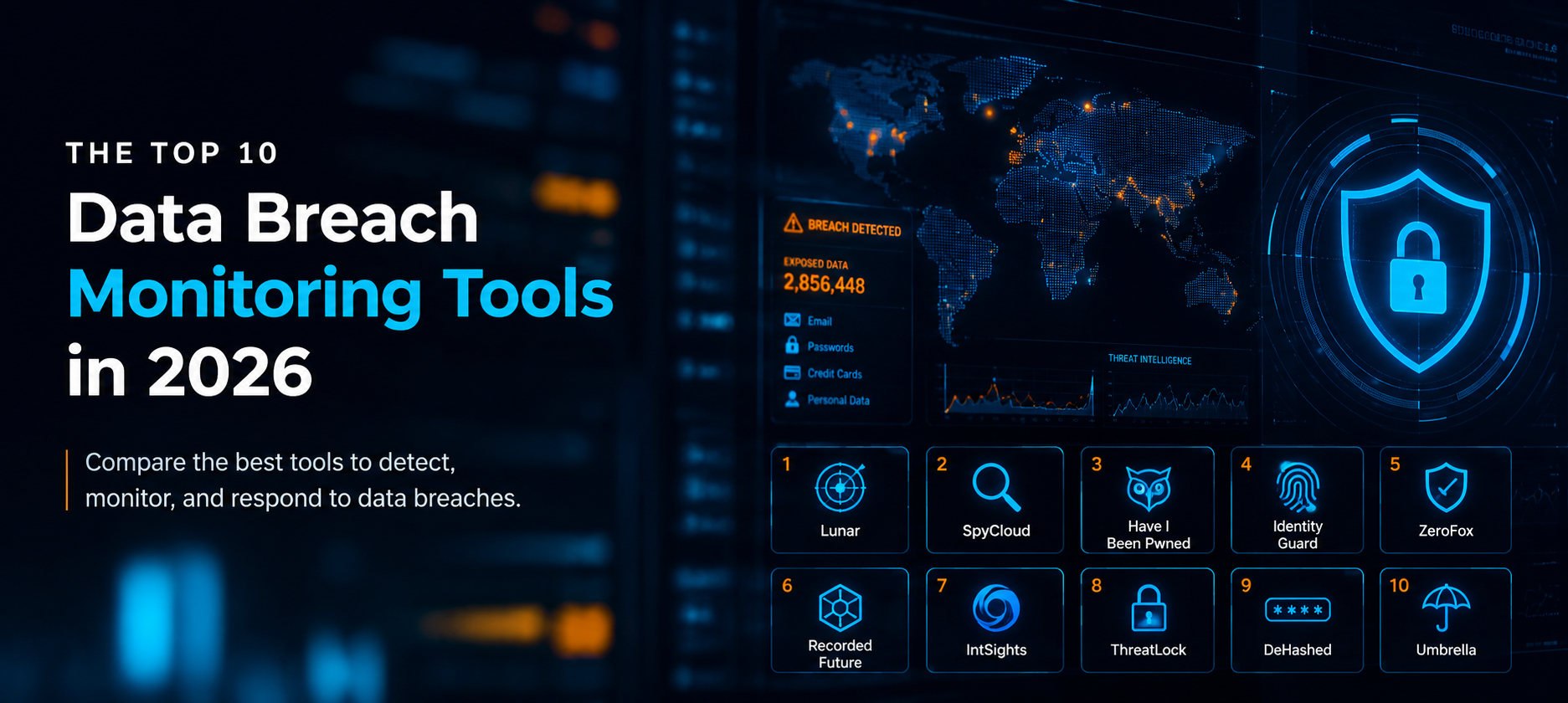
Top 10 Data Breach Monitoring Tools for 2026
1. Lunar by Webz.io
Primary applications: Breach monitoring, compromised credential detection, stolen cookie monitoring, infostealer visibility, and deep/dark web exposure tracking for companies of all sizes.
Key strengths: Lunar is built around the idea that breach visibility should be open and accessible. Its Community plan gives organizations free real-time credential exposure detection, infostealer and breach coverage, stolen session cookie detection, one year of historical coverage, machine-level forensic context, severity classification, and a centralized event feed. Paid tiers add deeper dashboards, reports, notifications, automations, API/webhook integrations, and advanced deep and dark web search.
Ideal customer profile: Companies that want a simple way to start monitoring exposed credentials and stolen cookies without waiting for a long enterprise sales process. Lunar is also a strong fit for security teams, MSSPs, and companies that want to operationalize breach monitoring across many domains, assets, and workflows.
Why it stands out in 2026: Lunar’s strongest angle is accessibility. Many breach intelligence products are locked behind expensive enterprise contracts. Lunar gives organizations a free path to see real credential and cookie exposure tied to their domain, then upgrade when they need automations, integrations, reporting, or deeper dark web search. That makes it useful both as a first breach monitoring layer and as a practical operational system for teams that need to respond quickly.
2. SpyCloud
Primary applications: Identity threat protection, account takeover prevention, malware intelligence, and post-infection remediation.
Key strengths: SpyCloud focuses heavily on recaptured criminal data, including stolen credentials, session cookies, identity data, and infostealer malware artifacts. Its malware intelligence material says it covers more than 105 infostealer malware families and helps teams see what attackers stole before it gets used.
Ideal customer profile: Enterprises, financial institutions, consumer platforms, and security teams that need to prevent account takeover at scale. SpyCloud is especially relevant where exposed customer or employee identities need to trigger forced resets, session invalidation, fraud checks, or downstream automation.
Best fit: Teams that already have mature identity, fraud, or security operations and need high-fidelity compromised identity intelligence.
3. Recorded Future Identity Intelligence
Primary applications: Enterprise threat intelligence, exposed credential detection, employee account takeover prevention, customer fraud prevention, and automated identity response.
Key strengths: Recorded Future’s Identity Intelligence product tracks exposed credentials across infostealer logs, malware combo lists, database dumps, and other sources. It is designed to add context and automate response so teams can shut down identity-based threats earlier.
Ideal customer profile: Large enterprises with an existing threat intelligence program, SOC workflows, SIEM/SOAR systems, and a need to connect identity exposure with broader threat actor, vulnerability, infrastructure, and campaign intelligence.
Best fit: Security teams that want breach monitoring as part of a larger intelligence platform rather than a standalone credential alerting tool.
4. Flashpoint
Primary applications: Compromised credential monitoring, infostealer intelligence, dark web intelligence, fraud investigations, and threat actor research.
Key strengths: Flashpoint says it collects exposed account pairs and infostealer malware logs from illicit communities, chat services, and deep and dark web spaces. Its 2026 infostealer guide also says it can collect and parse some infostealer logs within one to two days after infection.
Ideal customer profile: Enterprises, fraud teams, threat intelligence teams, and security operations groups that need strong criminal ecosystem context around exposed identities.
Best fit: Organizations that need both breach monitoring and analyst-grade intelligence around the underground communities where exposed data is traded.
5. Constella Intelligence
Primary applications: Identity risk intelligence, breach monitoring, exposed identity data, executive protection, fraud intelligence, and digital risk reduction.
Key strengths: Constella positions itself around identity risk intelligence, with monitoring across the surface, deep, and dark web. It describes its data lake as spanning more than one trillion attributes across 125+ countries and 50+ languages.
Ideal customer profile: Enterprises and technology partners that need identity exposure intelligence at large scale, including breached credentials, personal identity attributes, and broader identity risk signals.
Best fit: Organizations that treat exposed identity data as a risk category across cybersecurity, fraud, executive protection, and customer trust.
6. Flare
Primary applications: External threat exposure management, leaked credential monitoring, stealer log intelligence, dark web monitoring, and analyst investigation.
Key strengths: Flare provides credential browsing and stealer log intelligence. Its documentation describes a Credentials Browser for searching, reviewing, and managing leaked credentials, while its stealer log material says it alerts teams when employee credentials, session cookies, or corporate infrastructure access appear in newly distributed logs.
Ideal customer profile: Security teams that want a modern interface for external exposure, leaked credentials, infostealer logs, and dark web findings.
Best fit: Teams that need a practical analyst workspace for reviewing credential leaks and connecting exposure to broader external risk.
7. SOCRadar
Primary applications: Extended threat intelligence, dark web monitoring, external attack surface management, brand protection, and data leak detection.
Key strengths: SOCRadar combines threat intelligence with external attack surface management, brand protection, and dark web monitoring. Its free dark web report page says it aggregates leaked credentials, infostealer logs, black-market listings, and threat actor chatter to summarize a company’s exposure.
Ideal customer profile: Enterprises and MSSPs that want breach monitoring inside a broader external risk and threat intelligence platform.
Best fit: Teams that want dark web and breach monitoring connected to attack surface, brand abuse, and supply chain exposure.
8. Breachsense
Primary applications: Data breach monitoring, dark web monitoring, ransomware dump search, leaked credential detection, and API-first breach intelligence.
Key strengths: Breachsense describes itself as a dark web monitoring platform that watches hacker forums, ransomware leak sites, and infostealer logs for stolen credentials and company data. Its data breach monitoring page emphasizes fast detection of leaked credentials and ransomware dump search.
Ideal customer profile: Security teams that want a focused breach monitoring product with API access and direct visibility into stolen credentials and company data.
Best fit: Organizations that want practical breach detection without adopting a broad threat intelligence suite.
9. Kaseya Dark Web ID
Primary applications: Credential monitoring and dark web exposure detection for MSPs, MSSPs, and IT service providers.
Key strengths: Kaseya’s Dark Web ID focuses on identifying exposed credentials and sensitive user information early so teams can address it before unauthorized access or identity theft occurs. Kaseya also offers credential monitoring as part of Kaseya 365, with continuous scans and alerts when user credentials are breached.
Ideal customer profile: MSPs and IT teams that need credential exposure monitoring across many clients with manageable workflows and reporting.
Best fit: Service providers that want breach monitoring as part of a broader MSP security stack.
10. Have I Been Pwned
Primary applications: Verified domain breach search, individual breach lookup, pwned password checking, developer API access, and basic organizational exposure awareness.
Key strengths: Have I Been Pwned remains one of the most widely recognized breach checking services. Its API supports authenticated breached account lookups, domain search for verified domains, pastes, domain verification, stealer logs by subscription tier, and the free Pwned Passwords range API.
Ideal customer profile: Small teams, developers, security researchers, and organizations that need a trusted baseline for known breach exposure and password reuse checks.
Best fit: Organizations that want a simple breach visibility layer or want to integrate pwned password checking into account security workflows.
Comparison Table
| Tool | Coverage focus | Alerting and automation | Best use case |
|---|---|---|---|
| Lunar | Breach data, infostealer logs, stolen cookies, exposed credentials, deep and dark web search | Real-time detection, severity classification, event feed, notifications, API/webhooks on paid plans | Companies that want free, practical breach and cookie monitoring with an upgrade path |
| SpyCloud | Credentials, cookies, identity data, infostealer malware data | Identity protection and remediation workflows | Account takeover prevention and post-infection response |
| Recorded Future | Credentials, infostealer logs, combo lists, dumps, broader threat intelligence | Enterprise automation and intelligence workflows | Large SOCs tying identity exposure to threat intelligence |
| Flashpoint | Credentials, infostealer logs, illicit communities, chat services, deep and dark web | Intelligence-led alerting and investigation | Fraud and threat intel teams tracking criminal data |
| Constella | Identity attributes, breach data, infostealer data, surface/deep/dark web | Identity risk workflows and data access | Identity risk intelligence at enterprise scale |
| Flare | Leaked credentials, stealer logs, dark web exposure, external risk | Analyst workflows, credential browsing, alerts | Security teams managing external exposure |
| SOCRadar | Dark web, leaked credentials, infostealer logs, attack surface, brand risk | Extended threat intelligence alerts and integrations | Teams combining breach monitoring with external risk |
| Breachsense | Hacker forums, ransomware leak sites, infostealer logs, stolen credentials | API-first monitoring and alerts | Focused breach detection for security teams |
| Kaseya Dark Web ID | Exposed credentials and sensitive information | MSP-friendly credential alerts and reporting | MSPs managing credential exposure for clients |
| Have I Been Pwned | Known breaches, verified domain search, pwned passwords, API checks | API-based lookups and domain monitoring | Baseline breach checking and password exposure workflows |
What to Look For in a Data Breach Monitoring Tool
A good breach monitoring platform should do more than tell you that an email address appeared somewhere online. Security teams need enough context to act. That means source freshness, password status, cookie or token exposure, infected machine details, malware family, URL context, affected domain, user role, severity, and suggested remediation.
Freshness matters because attackers move fast. A credential from a ten-year-old forum dump has a different risk profile than a stealer log from yesterday. Session cookies and tokens create even more urgency because they can bypass normal login controls. API keys and developer credentials need their own path because remediation often requires key rotation, code search, CI/CD checks, and vendor access review.
The best tools also reduce noise. Large organizations will find old employee accounts, personal signups, aliases, recycled domains, contractors, and customer addresses in breach data. The useful platform separates what is merely present from what is actionable.
Data Breach Monitoring vs. Dark Web Monitoring
The two categories overlap, but they are not identical.
Dark web monitoring focuses on hidden and underground sources: forums, marketplaces, ransomware blogs, Telegram channels, paste sites, and threat actor communities. Data breach monitoring focuses on exposed data itself: credentials, customer records, employee accounts, passwords, cookies, tokens, files, source code, and sensitive business data.
A strong breach monitoring program usually needs both. Dark web sources show where attackers trade and discuss access. Breach data shows what can be used against the organization. Infostealer logs connect the two because they reveal the machine, the account, the browser context, and the services attackers may try next.
FAQs
What is data breach monitoring?
Data breach monitoring is the continuous detection of exposed credentials, personal data, customer records, corporate accounts, stolen cookies, tokens, and other sensitive information across breach dumps, infostealer logs, dark web sources, ransomware leak sites, paste sites, and related criminal ecosystems.
Is data breach monitoring useful if we already use MFA?
Yes. MFA helps, but it does not remove the risk. Infostealers can capture session cookies and other artifacts that allow attackers to hijack active sessions or understand where a victim has access. Breach monitoring helps teams detect exposure that internal login controls may not catch quickly enough.
What is the difference between breach data and infostealer data?
Breach data usually comes from leaked databases, dumps, combo lists, or exposed systems. Infostealer data comes from malware-infected machines and often includes browser credentials, cookies, autofill data, URLs, screenshots, device details, and other local artifacts. Infostealer data is often more operationally useful because it shows what the attacker may be able to access right now.
Should small companies use breach monitoring?
Yes. Small companies often have fewer security controls and fewer people watching for exposed credentials. A free or low-friction tool such as Lunar or Have I Been Pwned can give a company immediate visibility into exposed accounts, then the company can add paid workflows when it needs reporting, alerts, automation, or integrations.
What should a company do after finding exposed credentials?
Start with the accounts that still exist, have privileged access, or connect to important systems. Reset passwords, revoke sessions, rotate tokens and API keys, review MFA status, check recent login history, inspect the affected device, and verify whether the same password was reused elsewhere. For infostealer events, machine-level investigation matters because the exposed credential may only be one part of the compromise.


 Previous post