
The Visible Breach
The KDDI incident looks, at first glance, like a familiar credential breach: a large telecom operator, an exploited third-party software flaw, and a mass password-change campaign. KDDI disclosed that on June 17, 2026, it confirmed unauthorized access to an email system it provides to ISP operators, modified the system the same day, identified the suspected access point, and deployed technical defenses. Its investigation tied the intrusion to a vulnerability in third-party software used inside that email system.
The possible exposure reaches up to 14.22 million mailbox-linked email addresses and passwords across six services: STNet’s Pikara services, KDDI Web Communications’ CPI hosted email, J:COM NET and cable operator mail services, Chubu Telecommunications’ Commufa services, @nifty Mail, and BIGLOBE Mail. KDDI’s figure includes current users, former customers, and dormant customers, and the company says some passwords were hashed or encrypted.
That is the part most coverage has emphasized: scale, shared infrastructure, a third-party vulnerability, password resets, and the open question of how many credentials were directly usable. BleepingComputer highlighted the exposure size, the six-ISP footprint, the third-party software issue, and KDDI’s limited public detail on password protection methods.
The Overlooked Story: Old ISP Email as Identity Infrastructure
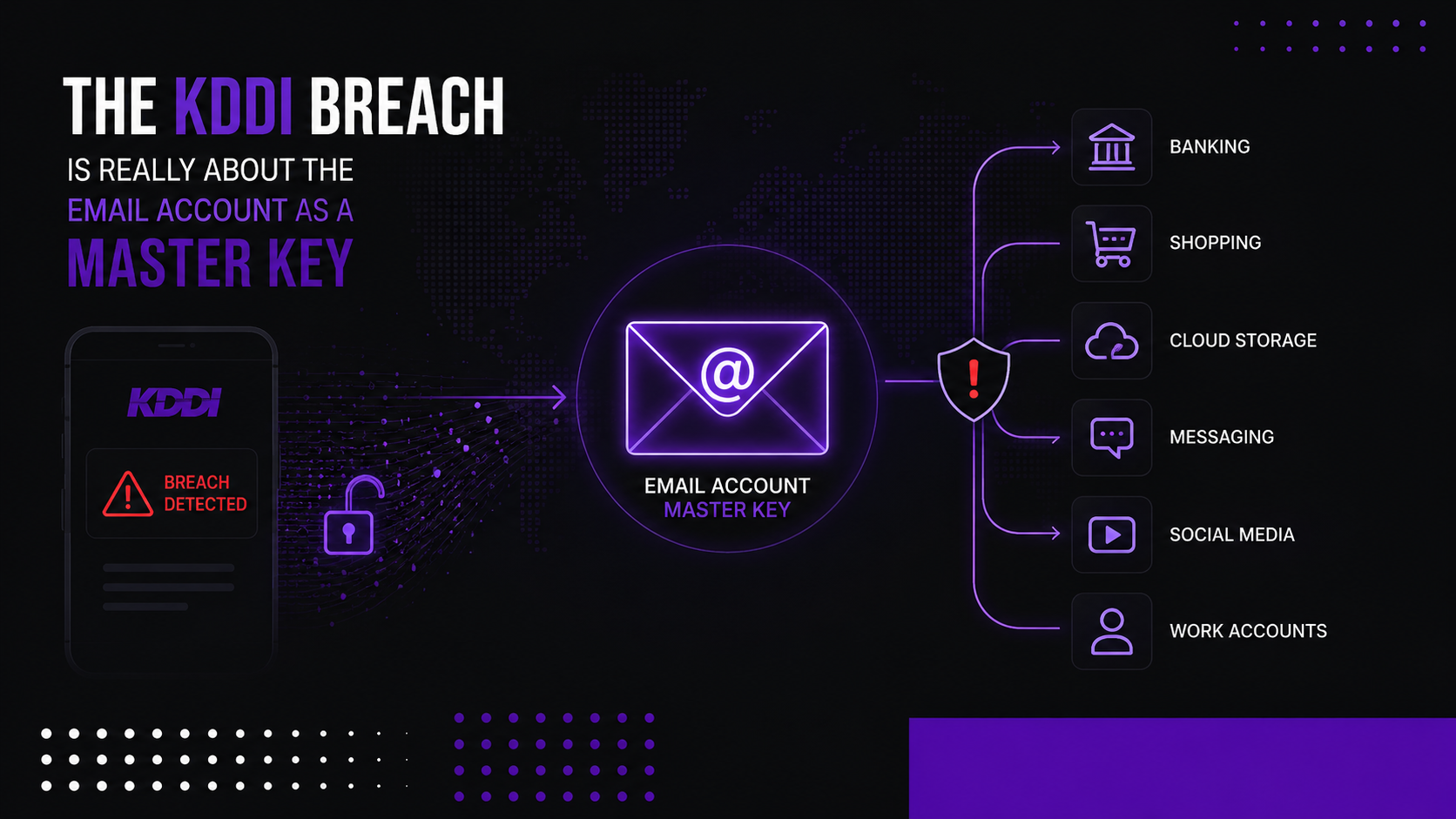
The more important angle sits beneath the word “email.” A compromised mailbox is rarely just a mailbox. For many people, especially long-time ISP customers, an ISP email address became a recovery address, billing address, account username, and archive of identity signals. The U.S. Federal Trade Commission describes the core danger clearly: a hacked email account lets an attacker request password reset links for other accounts, receive those links, change the passwords, and lock the real user out.
That makes the KDDI incident an identity-recovery incident as much as a telecom breach. The most sensitive downstream value may sit outside KDDI’s own systems: banks, shopping sites, social platforms, utilities, domain registrars, cloud services, loyalty programs, and old work tools that still trust an ISP mailbox for account recovery. The dormant-account detail matters because a forgotten mailbox can remain alive in other services’ recovery workflows long after the subscriber stopped thinking of it as important. KDDI’s inclusion of canceled and inactive customers turns this from a current-user response problem into a long-tail identity problem.
The Password Reset Became Its Own Attack Surface
The response pattern shows a second hidden risk: mass password rotation creates confusion, support pressure, and phishing opportunity. @nifty told users to change affected mail passwords by June 25 at 23:59 and said unchanged mail passwords would be invalidated in sequence. It also explained that some users may need to update stored passwords inside Outlook, Mac Mail, iOS, or Gmail, and that login notification emails were temporarily paused due to load countermeasures.
BIGLOBE’s notice shows a different version of the same operational problem. It told members that BIGLOBE mail addresses, BIGLOBE IDs, and passwords may have leaked, added phone authentication guidance, and said it would begin resetting passwords from July 1 for customers who had yet to change them. After reset, users would lose access to BIGLOBE mail, My Page, and mail client sending or receiving until they completed recovery.
This is where attackers often gain an opening. A real breach creates real password-change emails, real urgency, real service disruption, and real customers searching for instructions. That environment rewards convincing fake reset pages. The security question shifts from “Did the attacker get a usable password?” to “Can users distinguish a legitimate reset flow from a cloned one while several brands, portals, passwords, and mail clients all require attention?”
Shared Email Platforms Create Shared Identity Blast Radius
The KDDI breach also illustrates a structural risk in telecom outsourcing. The public brand facing the customer may be @nifty, BIGLOBE, J:COM, CPI, Commufa, or Pikara, while the vulnerable layer may sit deeper inside a shared provider platform. J:COM said the system provider was KDDI and that affected information could include email addresses plus passwords or password hashes. KDDI Web Communications similarly said CPI email used KDDI’s ISP-facing mail system and that the cause traced to exploited third-party software in that system.
This is exactly the kind of dependency problem supply-chain security frameworks warn about. NIST describes cybersecurity supply-chain risk management as identifying, assessing, and mitigating risks across ICT and operational technology products and service supply chains across the full system life cycle. NIST SP 800-161 also stresses that organizations lose visibility into how acquired technology is developed, integrated, deployed, and secured across suppliers.
The interesting lesson is that “six ISPs” may be the wrong mental model. A better model is “one identity-adjacent backend with six customer-facing brands.” In that model, every consolidation benefit, from shared operations to unified mail infrastructure, carries a blast-radius cost. A single vulnerable component can place millions of separate customer relationships into the same risk event.
Hashes Help, Yet the Recovery Layer Still Matters
KDDI’s statement that some passwords were hashed or encrypted is meaningful. Strong password hashing can turn a stolen password database into a slower and more expensive cracking problem. The public material leaves several crucial details outside view: the ratio of hashed, encrypted, and plaintext passwords; the algorithm choices; the use of salts; the encryption key architecture; and the exposure path available to the attacker.
Even a perfectly protected password store leaves a second class of risk: the email address itself. Email addresses are durable identifiers. They appear in breach corpuses, customer records, contact lists, invoices, archived correspondence, and recovery systems. OWASP explains that credential stuffing uses exposed username-password pairs against other sites, and also notes that leak information can support password resets through recovery emails and other personal data.
That makes password storage only one layer of the story. The wider exposure is a map of identity relationships. Attackers can test reused passwords, search old breach collections for matching addresses, send tailored phishing, and look for services where the ISP mailbox remains a trusted recovery endpoint.
The Real Fix Is Recovery Hygiene
For users, the strongest response is broader than changing the ISP mail password. The affected mailbox should be treated like a master recovery account. Every important service using that address deserves review, starting with financial accounts, mobile carrier portals, domain registrars, cloud storage, shopping accounts with stored payment cards, government services, and social platforms. The recovery email on those services should point to a secured mailbox with strong multi-factor authentication where available. The ISP password should be unique, and any reused password should be replaced everywhere it appears.
For ISPs and platform operators, the key lesson is recovery governance. Email systems serving as account-recovery anchors deserve the same discipline as payment systems or identity providers. That means forcing reset for exposed secrets, publishing clear brand-specific guidance, rate-limiting recovery abuse, monitoring login attempts after disclosure, validating phishing takedowns quickly, and maintaining a supplier inventory detailed enough to explain which third-party component can touch which credential class.
The KDDI incident will likely be remembered for the number, 14.22 million. The better memory is the shape of the risk: a shared ISP mail platform became a possible gateway to many private identity graphs. The breach’s deepest lesson is simple. Legacy email accounts are still keys, even when their owners think of them as old mailboxes.


 Previous post