
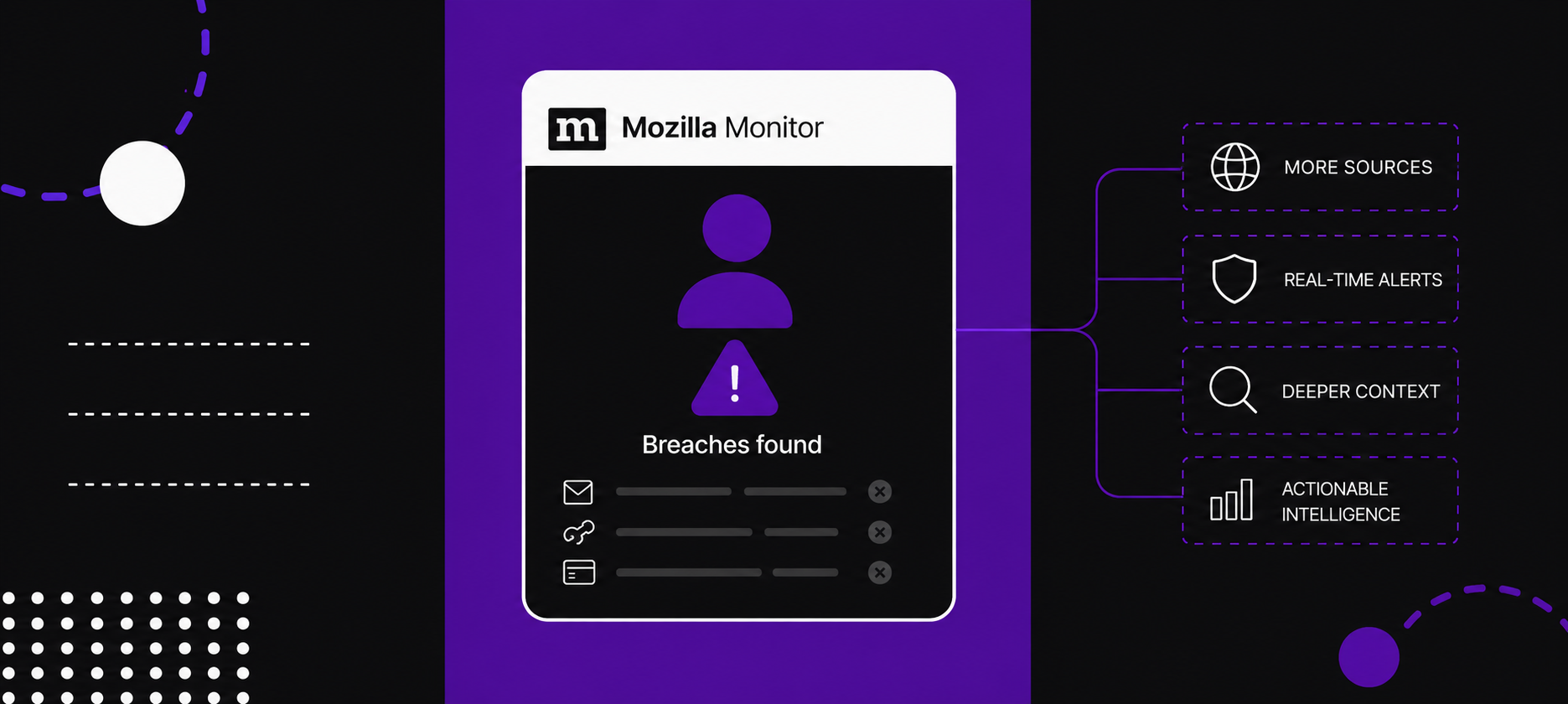
Mozilla Monitor is a good tool for one very specific job: telling people when an email address appears in known data breaches. That makes it useful, especially for consumers who want a simple way to understand whether their personal information has already been exposed. But it is important to understand what Mozilla Monitor does, what it does not do, and why relying on it alone creates a false sense of security.
Mozilla Monitor works by checking email addresses against known breach data. A user enters an email address, verifies it, and Mozilla Monitor alerts the user when that address appears in a breach database. The service also provides guidance on what to do next, such as changing passwords, enabling multi-factor authentication, watching for fraud, or taking other account-protection steps.
That is valuable. Most people do not know when their data has been leaked. They reuse passwords. They forget old accounts. They miss breach-notification emails. A simple alerting service can turn an invisible risk into something visible.
But visibility is not the same as protection.
The first limitation is that Mozilla Monitor depends on known breach data. It can only alert users about breaches that have already been discovered, processed, and added to its underlying breach source. If a company has not detected an incident, has not disclosed it, or the breach data has not reached the database, Mozilla Monitor cannot warn the user. This creates a timing gap between compromise and awareness. In cybersecurity, that gap matters. Attackers do not wait until a breach appears in a public notification database before they use stolen credentials.
The second limitation is that Mozilla Monitor is mostly reactive. It tells users that exposure happened. It does not prevent the breach, stop account takeover, rotate passwords, remove malware, block phishing, or monitor all the places where stolen data may circulate before it becomes part of a structured breach database. By the time a user receives an alert, the data may already have been copied, resold, tested in credential-stuffing attacks, or used for social engineering.
The third limitation is that email-based monitoring is narrow. An email address is an important identifier, but it is not the whole risk picture. Criminals trade many kinds of data: usernames, passwords, session cookies, phone numbers, addresses, identity documents, payment details, employee credentials, corporate domains, internal systems, and personal information collected from multiple sources. A breach alert tied to one email address does not necessarily reveal the full exposure of a person, family, executive, employee, or organization.
The fourth limitation is remediation. Mozilla Monitor can guide users, but it cannot do most of the hard work for them. If a password was reused, the user must change it everywhere. If a financial account is at risk, the user must monitor it. If identity data was exposed, the user may need to place fraud alerts, freeze credit, contact institutions, or watch for scams. The tool can point users in the right direction, but the actual cleanup remains manual, fragmented, and easy to miss.
The fifth limitation is data broker exposure. Mozilla previously offered Monitor Plus, a paid service that scanned certain data broker sites and helped remove personal information. That service has shut down. As a result, Mozilla Monitor is no longer enough for people who need ongoing data broker removal. This matters because data broker exposure is not a one-time breach event. Broker profiles can reappear after removal, new brokers can collect the same information, and public-record-based data can continue to circulate. A one-time scan or a breach alert does not solve that problem.
The sixth limitation is that breach alerts do not equal dark web intelligence. Modern exposure happens across many channels: criminal forums, Telegram groups, stealer-log markets, paste sites, credential dumps, phishing kits, botnet logs, and private trading channels. Some of this data eventually reaches public breach-notification systems. Much of it may not, or may arrive late. A consumer breach alert service is not the same as continuous threat intelligence across the criminal web.
This is especially important for businesses. A consumer may only need to know, “Was my email in a breach?” A company needs to know much more: Are employee credentials being sold? Are executives exposed? Are customer accounts at risk? Are stolen cookies or session tokens circulating? Are criminals discussing our brand, infrastructure, customers, or suppliers? Are compromised credentials connected to SaaS tools, cloud systems, VPNs, developer platforms, or admin panels? Mozilla Monitor was not designed to answer those questions.
That does not make Mozilla Monitor bad. It makes it incomplete.
For individuals, Mozilla Monitor should be treated as a starting point. It can help people discover known exposure and take basic steps. But users still need strong password hygiene, a password manager, multi-factor authentication, credit monitoring where relevant, phishing awareness, device security, data broker removal, and ongoing privacy maintenance.
For organizations, the gap is even larger. Companies need continuous external exposure monitoring, dark web and open web intelligence, employee credential detection, brand abuse monitoring, third-party risk visibility, incident-response workflows, and automated remediation processes. A breach alert for email addresses is only one small signal in a much broader risk landscape.
The core issue is simple: Mozilla Monitor tells you when some of your data has already appeared in known breach records. It does not give you full visibility into where your data is being traded, how criminals may use it, whether your organization is being targeted, or what exposures are emerging right now.
So the right conclusion is not “Do not use Mozilla Monitor.” The right conclusion is: use it, but do not confuse it with complete protection.
Mozilla Monitor is useful for awareness. It is not enough for prevention. It is not enough for remediation. It is not enough for identity protection. And it is not enough for companies that need real-time intelligence about compromised credentials, exposed assets, cybercriminal chatter, and emerging digital risk.
In a world where stolen data moves quickly, quietly, and across many channels, breach notification is only the first layer. Real protection requires a broader, continuous approach.


 Previous post