
The Cybersecurity Industry Has Been Looking at the Wrong Unit of Analysis
For most of the past three decades, cybersecurity has focused on attacks. Researchers analyzed malware samples, security teams tracked indicators of compromise, and threat intelligence programs cataloged threat actors. Every ransomware incident, phishing campaign, and data breach was treated as a standalone event requiring investigation and response.
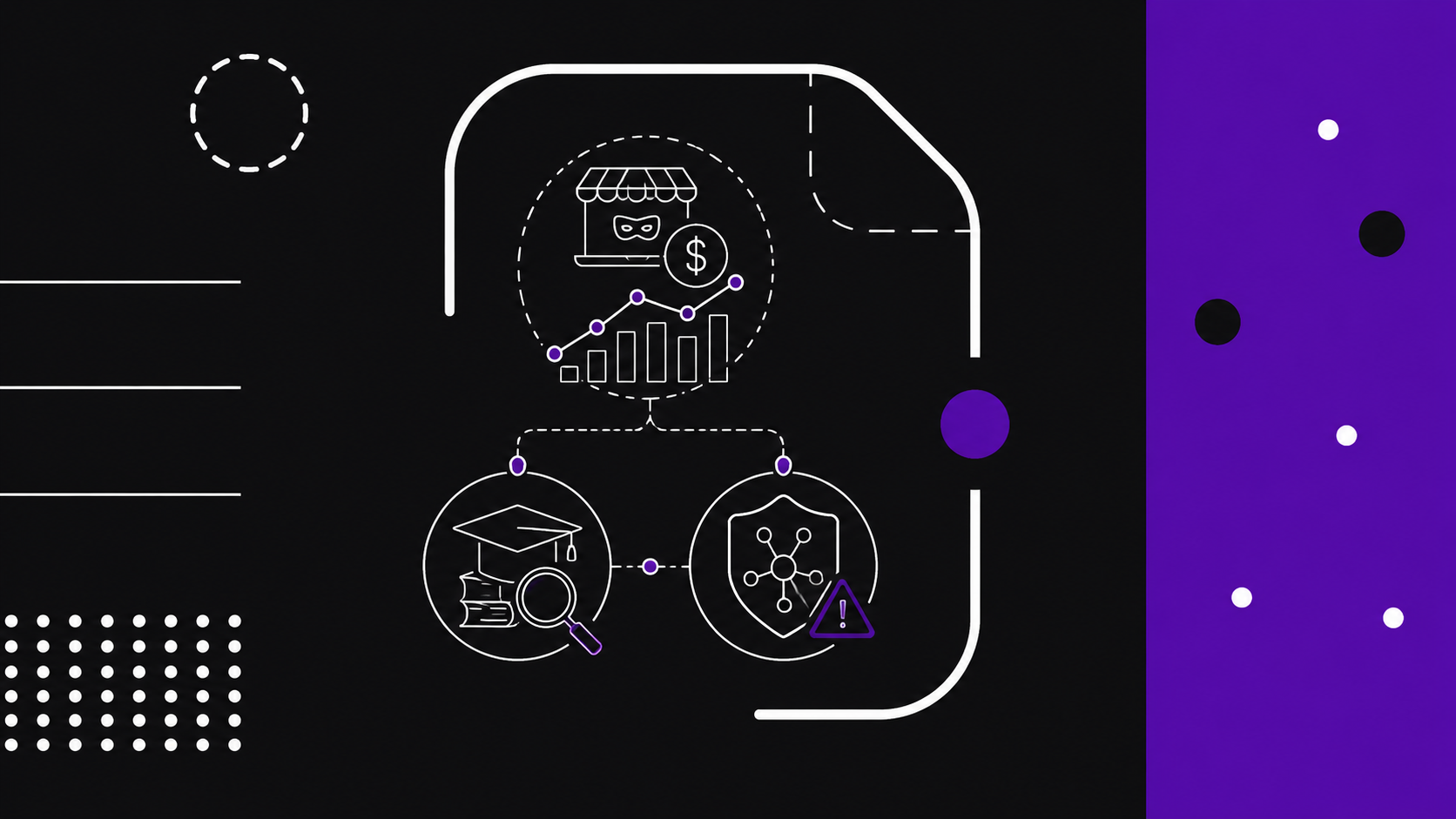
A growing body of academic research suggests this perspective captures only a fraction of the problem. Recent studies presented at the IEEE Symposium on Security and Privacy, the USENIX Security Symposium, and the ACM Conference on Computer and Communications Security increasingly examine cybercrime as an ecosystem rather than a collection of attacks. Researchers are mapping relationships between underground marketplaces, malicious infrastructure, cryptocurrency networks, service providers, and criminal communities to understand how modern cybercrime actually functions.
This shift matters because attacks are temporary while ecosystems endure. Malware families disappear, marketplaces shut down, and threat groups fragment. The economic structures that enable cybercrime continue to operate, adapt, and generate new opportunities for criminal activity. Understanding those structures has become one of the most important frontiers in cybersecurity research.
Cybercrime Has Become a Specialized Global Industry
One of the strongest themes emerging from academic literature is the industrialization of cybercrime. The image of a lone hacker operating independently has been replaced by a highly specialized ecosystem that mirrors many characteristics of legitimate digital industries.
Research into underground marketplaces and criminal forums reveals an extensive division of labor. Initial Access Brokers specialize in obtaining entry into corporate networks and selling that access to other actors. Malware developers focus on creating tools and platforms that affiliates can deploy. Infrastructure providers offer hosting environments designed to support malicious operations. Data brokers package and distribute stolen information. Cryptocurrency specialists facilitate payments and laundering services.
The result is a cybercrime economy built around specialization and efficiency. Just as modern businesses outsource non-core functions to specialized providers, cybercriminal organizations increasingly purchase services instead of building capabilities internally. An actor seeking access to a corporate environment can acquire it through a marketplace. A ransomware operator can rent infrastructure, purchase credentials, and outsource money movement.
This specialization has transformed cybercrime into a scalable business model. Capabilities that once required significant technical expertise have become accessible through commercial relationships. The ecosystem lowers barriers to entry while increasing the efficiency of attacks across the board.
Stolen Data Has Become a Financial Asset
Data breaches are often viewed through the lens of the victim organization. Researchers increasingly focus on what happens after information is stolen.
Recent academic work, including studies presented at IEEE S&P 2025, examines stolen data markets as functioning economies. Credentials, authentication cookies, source code, financial records, personally identifiable information, and corporate access rights circulate through marketplaces where supply and demand determine value.
What makes these markets particularly interesting is their sophistication. Vendors build reputations. Buyers leave reviews. Dispute resolution mechanisms exist. Pricing reflects scarcity, quality, exclusivity, and monetization potential. Some markets even provide customer support and guarantees.
From a threat intelligence perspective, these markets generate signals that reveal future attacker behavior. Rising demand for certain types of credentials often reflects emerging attack trends. Increased valuation of access to particular industries may indicate shifting criminal priorities. Market behavior frequently provides visibility into future threats before technical indicators emerge.
This represents a profound shift in intelligence gathering. Researchers increasingly view underground marketplaces as economic forecasting systems that reveal where cybercrime is heading next.
Infrastructure Has Become the DNA of Cybercrime
Historically, threat intelligence focused heavily on malware analysis. Academic research increasingly points toward infrastructure as a richer source of intelligence.
Infrastructure includes domains, hosting providers, DNS services, cloud resources, certificate issuance systems, and network relationships. While malware changes rapidly, infrastructure leaves traces that are often much harder to conceal.
Researchers have demonstrated that malicious operations frequently share infrastructure characteristics even when they appear unrelated. Hosting choices, domain registration patterns, network proximity, certificate issuance behavior, and DNS configurations often reveal operational connections between campaigns.
Research projects such as MANTIS: Malicious Domain Detection Using Infrastructure Reputation illustrate how infrastructure signals can identify malicious domains before they become operational threats. By analyzing relationships between domains, hosting environments, and infrastructure providers, researchers can identify suspicious assets during the preparation phase rather than during active attacks.
This marks a significant evolution in threat intelligence. Instead of asking what attackers are doing today, researchers increasingly ask what attackers are building for tomorrow.
Cybercrime Behaves Like an Evolutionary System
One of the most fascinating developments in cybersecurity research comes from applying concepts from economics, ecology, and complexity science to cybercrime.
Researchers increasingly describe cybercrime as a complex adaptive system. New defensive technologies create environmental pressures. Criminal actors respond through experimentation. Successful techniques spread rapidly through underground communities. Ineffective approaches disappear.
This process resembles evolutionary adaptation.
When email security improves, attackers invest more heavily in social engineering. When organizations deploy stronger authentication mechanisms, criminals develop techniques for stealing session tokens and authentication cookies. When law enforcement dismantles a marketplace, participants migrate to alternative platforms while preserving commercial relationships and reputation systems.
The ecosystem continuously evolves through thousands of independent experiments taking place across the globe. Every successful innovation becomes part of the collective knowledge of the criminal economy.
This helps explain why cybercrime demonstrates such resilience. The ecosystem operates through decentralized adaptation rather than centralized control. Individual actors may disappear, yet the broader system continues to innovate and grow.
Cryptocurrency Created the Most Observable Criminal Economy in History
One of the great paradoxes of modern cybercrime is that the technologies embraced by criminals have simultaneously become valuable intelligence sources.
Public blockchains such as Bitcoin and Ethereum generate transparent transaction records that researchers can analyze at scale. Every transaction creates data. Every wallet forms relationships. Every transfer contributes to a growing map of financial activity.
Researchers increasingly use blockchain analytics to understand the structure of criminal ecosystems. Organizations such as Chainalysis and numerous academic institutions study transaction flows, wallet clustering, laundering behavior, cross-chain transfers, and exchange interactions to uncover relationships between actors and operations.
Unlike traditional organized crime, which often relied on opaque financial systems, large portions of the cybercrime economy generate publicly observable financial footprints. These footprints provide researchers with unprecedented visibility into criminal networks.
As a result, cybersecurity research is becoming increasingly interdisciplinary. Economists, data scientists, network theorists, and security researchers are working together to understand how value moves through digital criminal ecosystems.
Infrastructure Intelligence Is Replacing Indicator Intelligence
Traditional threat intelligence has long relied on indicators of compromise such as malicious IP addresses, URLs, domains, and file hashes. Frameworks such as MITRE ATT&CK helped standardize how organizations understand adversary behavior and attack techniques.
Academic research is increasingly focused on something deeper than indicators. Researchers are examining relationships.
Graph analysis, network science, and machine learning techniques are being applied to map connections between infrastructure, marketplaces, actors, cryptocurrency wallets, hosting providers, and attack campaigns. These relationships create patterns that remain visible even as individual indicators change.
A malicious domain may disappear tomorrow. The infrastructure supporting that domain often remains connected to other malicious assets. A threat actor may abandon a malware family. Their financial relationships and infrastructure dependencies frequently remain intact.
The future of threat intelligence increasingly revolves around understanding these persistent relationships rather than cataloging isolated indicators.
The Future of Cybersecurity Lies in Understanding Systems
The most important lesson emerging from contemporary cybersecurity research is that cybercrime functions as a complex economic system.
Markets allocate resources. Competition drives innovation. Infrastructure enables scale. Financial networks facilitate growth. Reputation systems establish trust. Specialization increases efficiency. Every component contributes to an ecosystem that continuously evolves in response to opportunity and pressure.
Researchers at institutions such as Carnegie Mellon CyLab, the Berkeley Center for Long-Term Cybersecurity, and numerous international research groups are increasingly studying cybercrime through the lenses of economics, network science, behavioral analysis, and complex systems theory.
This broader perspective is reshaping threat intelligence. The field is moving beyond malware analysis and incident investigation toward ecosystem analysis and predictive modeling. Organizations that understand cybercrime ecosystems gain visibility into the forces that generate threats rather than simply observing the threats themselves.
The next decade of cybersecurity will likely be defined by this transition. Threat intelligence is evolving into ecosystem intelligence. The organizations that succeed will understand not only how attacks happen, but why entire criminal economies continue to generate them.
Further Reading
IEEE Symposium on Security and Privacy: https://www.sp2025.ieee-security.org/accepted-papers.html
USENIX Security Symposium: https://www.usenix.org/conference/usenixsecurity25
ACM CCS: https://www.sigsac.org/ccs/
arXiv Security and Cryptography Research: https://arxiv.org/list/cs.CR/recent
MITRE ATT&CK Framework: https://attack.mitre.org


 Previous post