
The Conversation Has Shifted, Yet the Identity Problem Has Deepened
Cybersecurity teams are spending 2026 talking about AI-augmented attacks, exploit velocity, ransomware pressure, shadow AI, SaaS exposure, and the continued rise of infostealer markets. The conversation has good reason. Verizon’s 2026 Data Breach Investigations Report says 31% of breaches now start with software vulnerabilities, 48% involve ransomware, generative AI is strengthening 15 attack techniques, and mobile phishing produces 40% higher click rates than traditional email phishing.
The fashionable takeaway is that attackers have moved toward faster exploitation and broader automation. The deeper takeaway is more interesting: stolen identity material remains the connective tissue after the first door opens. A vulnerability may create entry. Credentials, session tokens, API keys, service accounts, help desk resets, SaaS integrations, and OAuth grants determine how far the attacker can travel, what data can be reached, and how quickly extortion becomes credible.
The Quiet Metric Is Credential Survivability
Most breach monitoring begins with a simple question: “Has our data appeared somewhere?” That question produces alerts, dashboards, dark web hits, and executive anxiety. A stronger strategic question is: “Can this exposed identity material still be redeemed for access?”
Call this credential survivability. It measures how long a password, token, API key, browser cookie, OAuth grant, SSO assertion, contractor credential, or service secret remains useful after exposure. It also measures the conditions that let exposed material become a session: MFA coverage, token lifetime, role scope, network allow lists, device trust, reset workflows, help desk scripts, dormant accounts, vendor access, and data permissions.
This lens changes breach monitoring from a discovery service into a risk operating system. A leaked password with phishing-resistant MFA, tight device binding, fast rotation, and restricted privilege has a short dangerous life. A leaked contractor credential tied to a SaaS data warehouse, active for years, reachable from any network, and protected by only a username and password has a long dangerous life. The second case is where breach monitoring becomes board-level risk.
Snowflake Showed the Future of Breach Monitoring
The 2024 Snowflake customer campaign remains one of the clearest examples of credential survivability in action. Mandiant’s analysis of UNC5537 reported that attackers systematically compromised Snowflake customer instances using stolen customer credentials, advertised victim data on cybercrime forums, and attempted extortion. Mandiant traced the incidents it handled to compromised customer credentials, with infostealer malware as a major source, and stated that about 165 potentially exposed organizations were notified.
The most important detail is age. Mandiant found that many credentials used in the campaign came from historical infostealer infections, some dating back to 2020, and at least 79.7% of accounts leveraged by the threat actor had prior credential exposure. The campaign succeeded through familiar control failures: accounts configured for single-factor login, credentials that stayed valid for years, and customer instances reachable beyond trusted network locations.
This is the point many breach conversations glide past. The breach intelligence signal existed long before the extortion event. The dangerous asset was the afterlife of the credential. The password had outlived the laptop infection, the original compromise, the employee workflow, and the organization’s security memory. A credential intelligence program built around survivability would have treated those old secrets as active access paths rather than historical residue.
Infostealers Turn Personal Devices Into Enterprise Identity Sensors
Mandiant’s M-Trends 2025 data shows the same structural pattern. In its incident response work, exploits remained the most common initial infection vector at 33%, while stolen credentials rose to second place at 16%. Mandiant also highlighted infostealer operations, cloud migration gaps, unsecured data repositories, and centralized authority stores such as SSO portals as major themes for defenders.
The quieter implication is that many enterprise identity exposures originate outside managed enterprise visibility. In the Snowflake campaign, Mandiant observed contractor systems used for personal activity, including gaming and pirated software downloads, and noted that a single compromised contractor laptop can create access risk across multiple organizations when it holds credentials for several clients.
That turns credential intelligence into a supply-chain discipline. Companies need to understand which external identities can touch crown-jewel systems, which vendors can reset or rebind access, which personal devices appear in infostealer telemetry, and which exposed credentials still map to live enterprise roles. The risk sits in the relationship graph as much as in the leaked string.
The Help Desk Is Part of the Credential Surface
Scattered Spider shows another piece of the same story. The Australian Cyber Security Centre’s Scattered Spider advisory describes a group that targets large companies and contracted IT help desks. The advisory says the group uses push bombing, SIM swapping, help desk impersonation, one-time password collection, password reset manipulation, and MFA token transfer tactics. The July 2025 update adds a sharper pattern: actors posed as employees to convince IT or help desk staff to reset passwords and move MFA to attacker-controlled devices.
This matters because breach monitoring programs often treat credentials as technical artifacts. Scattered Spider treats credentials as social artifacts. The attacker studies roles, support procedures, social media, commercial intelligence, database leaks, SSO naming patterns, and help desk verification steps. The ACSC advisory says the group uses personal information from social media, open-source information, commercial intelligence tools, and database leaks to enrich social engineering.
Credential intelligence should therefore include recoverability intelligence. An exposed password becomes far more valuable when the attacker can also acquire identity proofing details, call the help desk, transfer MFA, register a new token, and create persistence through SSO. In that world, the “credential” includes the recovery path.
The New Credential Is a Token, a Secret, and an Agent Permission
The next wave expands the definition of credential intelligence beyond passwords. Microsoft’s Digital Defense Report 2025 says Microsoft processes 38 million identity risk detections in an average day, and it identifies Lumma Stealer as the most prevalent infostealer observed between October 2024 and October 2025. Microsoft also describes Lumma as a malware-as-a-service platform that retrieves sensitive browser and application data, which can then be sold through forums and Telegram channels to access brokers and ransomware operators.
At the same time, software development and AI adoption are creating a parallel universe of non-human credentials. GitGuardian’s State of Secrets Sprawl 2026 research says 28.65 million new hardcoded secrets were added to public GitHub commits in 2025, a 34% year-over-year increase. It also says AI service secrets reached 1,275,105, up 81% year over year, and internal repositories are roughly six times more likely than public repositories to contain hardcoded secrets.
This is the machine-identity version of the same afterlife problem. A token in a repository, an API key in a Slack message, an MCP config file with embedded credentials, or a CI/CD runner secret may survive for months or years. GitGuardian says 64% of valid secrets from a 2022 dataset remained active when retested in January 2026.
Why AI Makes Survivability More Important
AI changes the speed of discovery, development, and exploitation. CrowdStrike’s 2026 Global Threat Report findings say average eCrime breakout time fell to 29 minutes in 2025, with the fastest observed breakout at 27 seconds. CrowdStrike also reported an 89% increase in attacks by AI-enabled adversaries compared with 2024, 82% malware-free detections, and cloud-conscious intrusions rising 37%, with valid account abuse accounting for 35% of cloud incidents.
The identity implication is clear. A defender who treats a leaked credential alert as a ticket queue item is working at human workflow speed. An adversary using AI-assisted reconnaissance, automated testing, credential stuffing infrastructure, infostealer log search, and SaaS enumeration is working at machine speed. The limiting factor becomes whether the organization can shrink credential survivability faster than attackers can convert exposure into access.
IBM’s Cost of a Data Breach 2025 research also points in this direction. IBM puts the global average breach cost at USD 4.4 million and recommends fortifying both human and machine identities through operational controls for non-human identities and phishing-resistant authentication such as passkeys.
Breach Monitoring Should Score Access After Exposure
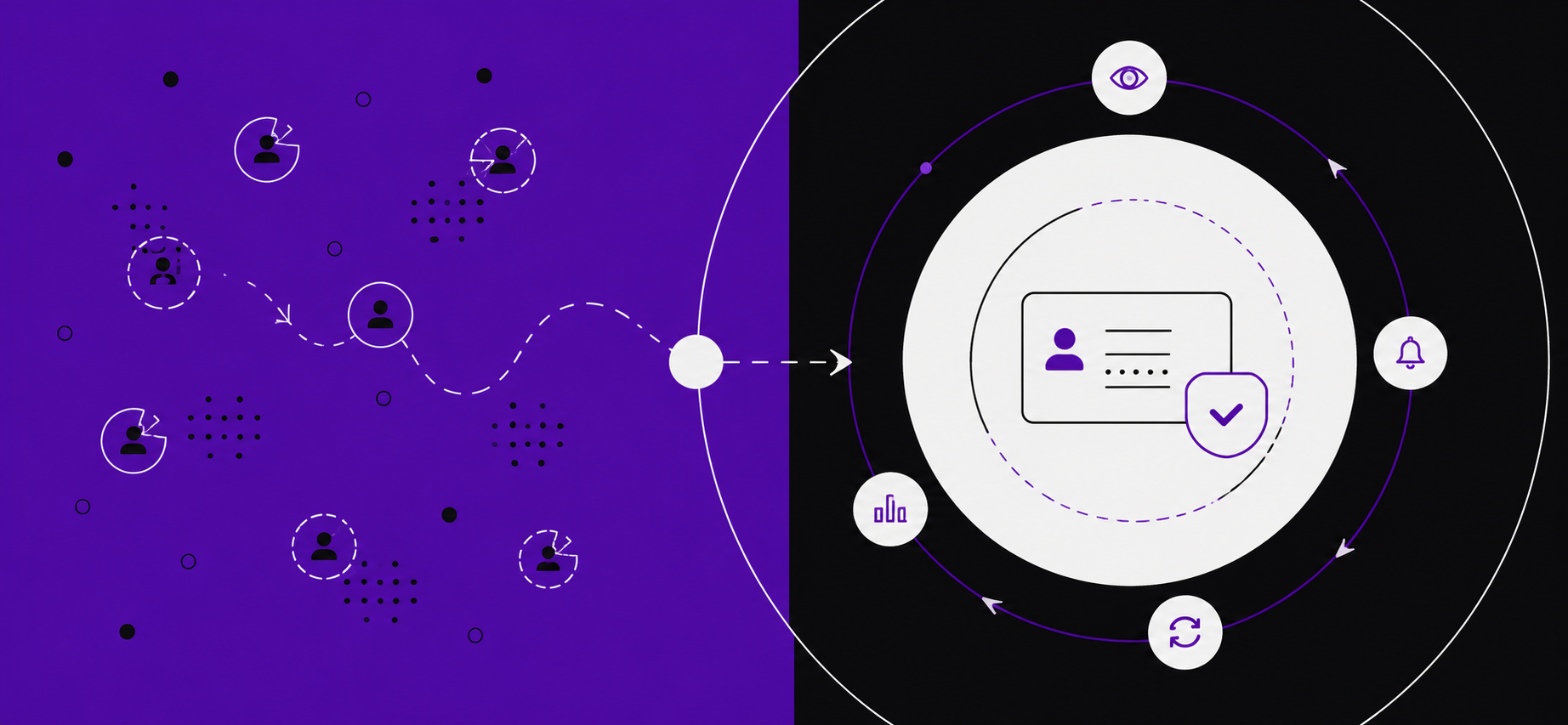
The under-discussed future of data breach monitoring is a shift from “find my leaked data” to “score the afterlife of every exposed identity.” That means every breach alert should answer richer questions. Is the credential still valid? Which identity owns it? Which applications accept it? Which MFA method protects it? Which sessions remain active? Which OAuth grants, refresh tokens, browser cookies, and API keys exist alongside it? Which help desk process can rebind it? Which vendors or contractors can use it? Which data stores sit behind it? Which machine identities share the same owner or deployment path?
NIST’s draft IR 8587 on protecting identity tokens shows how the policy world is starting to move toward this same concern. It focuses on protecting identity tokens and assertions from forgery, theft, and misuse, with recommendations for key management, token verification, lifecycle controls, SSO, federation, and API access scenarios.
That framing matters because the breach monitoring category grew up around exposed records, exposed emails, exposed passwords, and dark web mentions. The modern breach path runs through identity state. The valuable signal is live access potential. A credential intelligence platform should behave more like an air traffic control system for trust: tracking which credentials, tokens, accounts, devices, services, and recovery flows can still land inside the enterprise.
The Practical New Model
The strongest programs will combine breach monitoring, infostealer intelligence, secret scanning, identity posture management, SaaS access governance, endpoint telemetry, and help desk controls into a single loop. Discovery feeds the loop, while validation, containment, and lifecycle reduction create the value. Each exposed identity should trigger scoped rotation, session revocation, device review, privilege reduction, data-access analysis, and verification of recovery paths.
This model also changes ownership. Credential intelligence belongs with security operations, identity engineering, cloud security, application security, vendor risk, and HR operations together. A contractor credential from an unmanaged laptop, a dormant admin account in a SaaS tenant, a leaked API key in a repository, and a help desk process that can transfer MFA are four expressions of one problem: trust that survives past its safe context.
The Future Belongs to Teams That Shorten the Afterlife
The security market loves visibility, and breach monitoring sells visibility well. The next advantage comes from shortening the life of exposed trust. The winning metric will be the median time from exposure to uselessness: how quickly the credential, token, session, secret, or recovery path loses power.
That is the angle hiding in plain sight. Breach monitoring tells you what escaped. Credential intelligence should tell you what still works. The organizations that master that difference will treat every leaked credential as a perishable access object and every alert as a chance to shrink the attacker’s usable window. In a threat landscape defined by AI speed, infostealer markets, SaaS sprawl, and human recovery workflows, the safest credential is the one whose afterlife is measured in minutes.


 Previous post