
A Perimeter Story Disguised as a Password Story
FortiBleed became public as a story about tens of thousands of exposed Fortinet firewall credentials. That headline captures the scale, yet it leaves the deeper lesson in the background. The real story sits inside the configuration files, administrative secrets, identity links, VPN policies, and trust relationships that live on edge appliances.
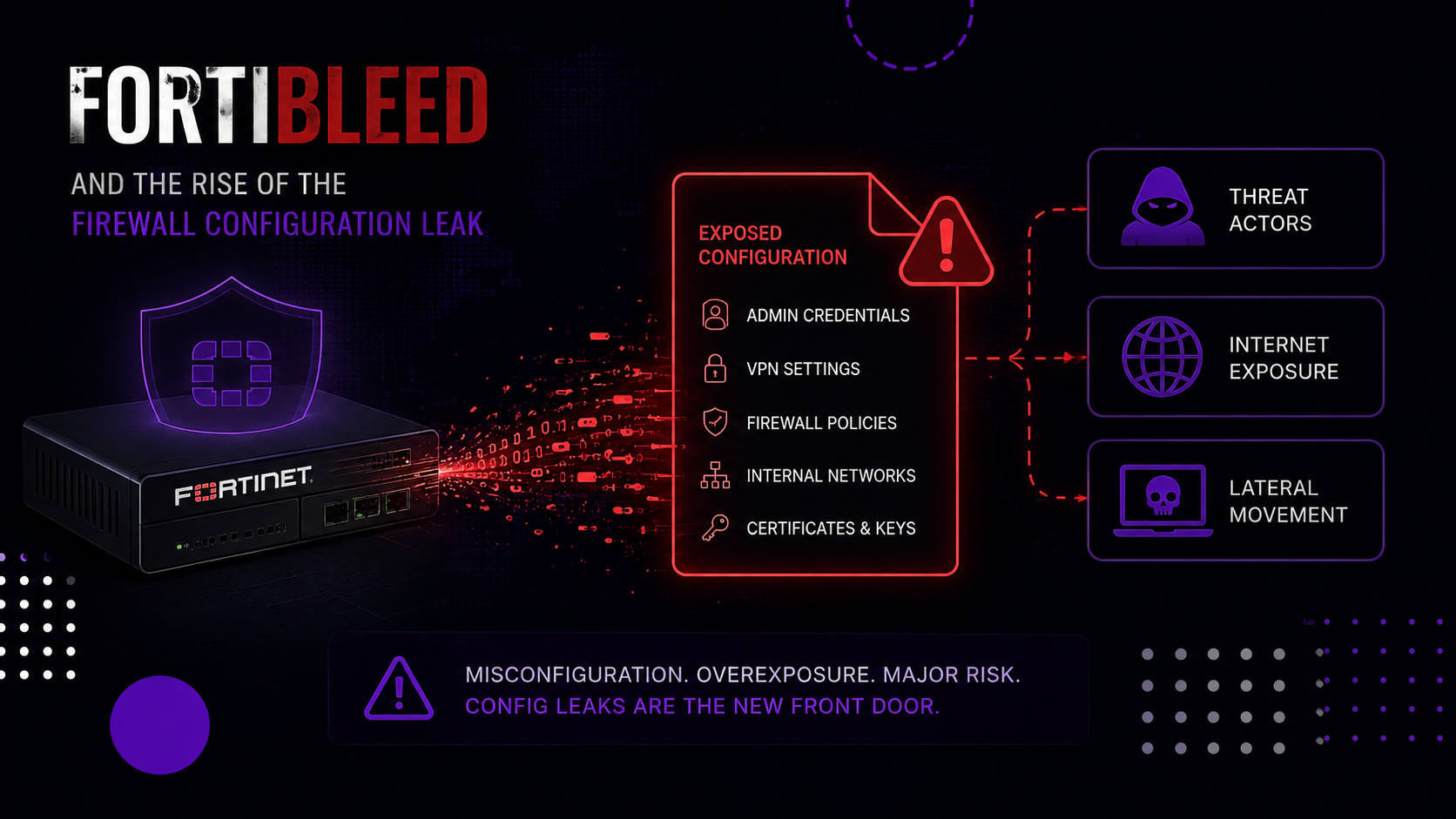
A firewall configuration is more than a technical backup. It is a compact model of an organization’s perimeter. It can describe who administers the device, which users connect remotely, which internal networks matter, which identity systems hold authority, which routes carry sensitive traffic, and which third parties receive trusted access. When attackers collect that material at scale, they gain far more than a login screen. They gain context.
That context changes the meaning of FortiBleed. A leaked password creates one immediate path. A leaked configuration creates a planning document for future intrusion. It turns the firewall into both target and map.
The Edge Device as a Secret Store
Modern firewalls sit at a strange intersection. They are security tools, network routers, VPN concentrators, identity brokers, policy engines, and administrative consoles at the same time. They hold credentials for local administrators, references to LDAP or RADIUS systems, VPN user structures, IPsec secrets, certificates, SNMP strings, API access, routing rules, and policy objects.
That combination makes them unusually valuable. A compromised laptop may reveal one user’s work. A compromised server may reveal one application’s data. A compromised firewall can reveal the shape of the entire environment.
FortiBleed shows how attackers increasingly treat edge devices as vaults. The device itself becomes useful, and the exported configuration becomes portable intelligence. Once copied, it can be searched, enriched, cracked, replayed, sold, validated, and reused across campaigns. The firewall stops being a single compromised asset and becomes a dataset.
The Quiet Risk of “Patched but Still Exposed”
One of the most important lessons concerns credential migration. Security teams often treat firmware updates as a finish line. Edge devices tell a more complicated story. When platforms improve password hashing or credential storage, old secrets may require additional events before they fully migrate into the stronger format. An administrator login, a password reset, or a configuration change can become part of the protection process.
That means a device can run a modern firmware version while still carrying older credential material inside its configuration. This distinction matters because attackers who obtain exported configs can work offline. Offline cracking turns time, hardware, and wordlists into access. It also allows attackers to separate collection from exploitation, which makes detection harder.
FortiBleed should push defenders to ask a more precise question. The right question is: which secrets inside the firewall configuration remain valid today? That question goes beyond firmware version, password length, and internet exposure. It reaches into the state of each credential, each trust link, and each reusable secret.
Configuration Theft Changes the Recovery Playbook
A normal password leak response centers on rotation. Reset the affected account, revoke active sessions, enforce MFA, and monitor for suspicious login attempts. That playbook works for many user credential incidents. Firewall configuration exposure requires a wider recovery model.
The response should treat the configuration as a set of secrets and pathways. Local admin accounts need rotation. VPN credentials need review. Identity integrations deserve special attention. RADIUS, LDAP, TACACS, SNMP, IPsec pre-shared keys, automation accounts, API tokens, backup accounts, break-glass users, and certificates may all require evaluation. Network policies and administrative access rules deserve comparison against known-good baselines. New local accounts, unusual admin profiles, changed VPN settings, and altered remote management exposure can reveal persistence.
This is where the story becomes operationally important. Many organizations have strong telemetry on endpoints and servers. Far fewer have the same level of forensic visibility on firewalls, VPN gateways, and other perimeter appliances. Attackers understand that gap. They can use edge devices as stable access points, traffic observation points, credential collection points, and pivots into the internal network.
The Open Directory as a Window Into an Industrial Process
The public discovery of FortiBleed came through exposed attacker infrastructure. That detail matters. Researchers gained visibility because the operators left behind an accessible collection point containing credentials, scripts, logs, histories, and operational artifacts. This gave defenders a rare look into the machinery behind large-scale perimeter exploitation.
That machinery appears industrial. Attackers gather candidate credentials, test them against internet-facing devices, record successful access, organize results, and enrich each hit with useful context. Config exports can then feed further cracking, validation, resale, and targeting. The process resembles a factory more than a single intrusion.
This industrial model turns every exposed management interface into a potential input. It also turns every reused secret into fuel. The output is a ranked inventory of reachable organizations, verified access, and perimeter intelligence.
The Bigger Pattern Behind FortiBleed
FortiBleed fits into a broader shift in attacker priorities. Enterprise security has improved around endpoints, cloud identities, and email. Perimeter appliances still sit in a less mature operational zone. They run critical services, face the internet, require urgent patching, and often fall between network, security, and infrastructure teams.
That split ownership creates opportunity. Edge devices may receive patches slower than servers. Logs may flow to separate systems. Backup files may sit in ticketing tools or shared folders. Administrative access may rely on old allowlists or shared accounts. Configuration exports may receive weaker handling than password vault entries, even though they can contain password-equivalent material.
The strategic issue is simple. Attackers increasingly value the boundary layer because it combines access and intelligence. FortiBleed made that visible at scale.
The Undercovered Lesson: Backups Are Breach Material
Configuration backups deserve the same sensitivity as credential vault exports. A firewall backup may contain hashed passwords, encrypted secrets, topology, identities, route maps, policy names, certificates, and system metadata. In many environments, those backups move through automation systems, managed service providers, email threads, support tickets, object storage, and local admin workstations.
The security industry often talks about exposed passwords and vulnerable appliances. It gives far less attention to the lifecycle of exported configurations. Who can create them? Where do they land? How long do they persist? Which systems index them? Which third parties store copies? Which old backups still contain valid secrets?
Those questions define the next maturity step. A secure firewall program should include config export control, backup encryption, secret redaction where possible, retention limits, access logging, integrity monitoring, and periodic rotation of secrets embedded in backups. This turns configuration handling into a core security discipline rather than an administrative afterthought.
A Better Way to Understand the Incident
FortiBleed should be understood as a warning about perimeter data exhaust. Every edge appliance produces artifacts that attackers can weaponize: configs, logs, session records, backup files, admin histories, VPN profiles, and identity links. Each artifact can extend an intrusion beyond the original device.
The industry already knows how to talk about credential leaks. It now needs a stronger language for configuration leaks. A credential leak says someone may log in. A configuration leak says someone may understand the perimeter well enough to choose the best way in.
That difference is the heart of FortiBleed. The event points to a future where attackers collect network edge intelligence at scale, build searchable access inventories, and turn forgotten appliance secrets into enterprise entry points. The organizations that learn from this story will treat firewall configurations as crown-jewel security material, verify secret migration after upgrades, rotate trust relationships after suspected exposure, and bring edge appliances into the same monitoring culture already applied to endpoints and cloud identities.


 Previous post