
What Credential Stuffing Means
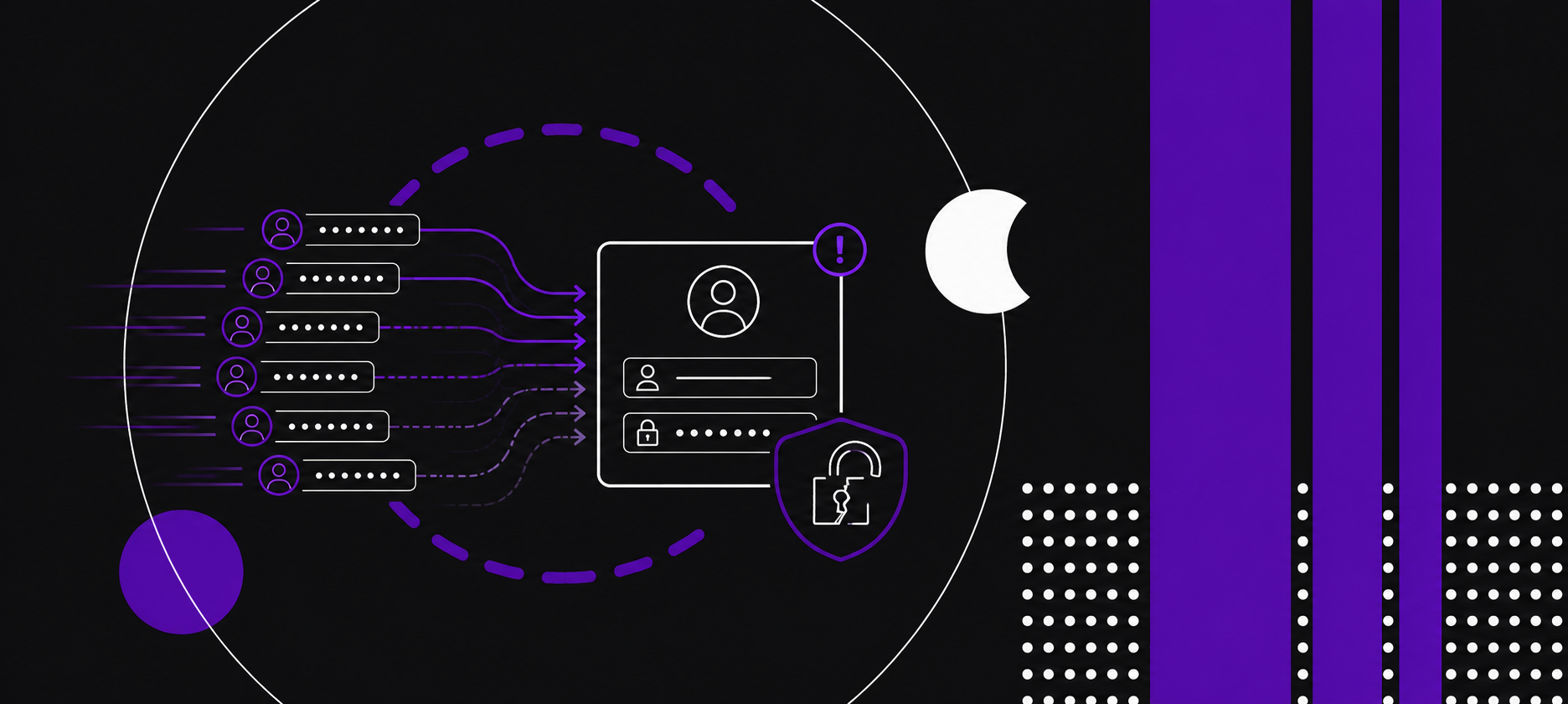
Credential stuffing is one of the clearest examples of how one breach can become many breaches. The attack is simple: criminals take usernames and passwords exposed in one leak and automatically try them on other websites, apps, banks, retailers, streaming services, SaaS tools, email accounts, cloud platforms, and corporate systems. They are betting on one common human habit: people reuse passwords.
OWASP defines credential stuffing as the automated injection of breached username and password pairs into login forms to fraudulently gain access to accounts. The attacker is not usually guessing passwords from scratch. That would be brute force. They are replaying credentials that were already stolen somewhere else. This is what makes the attack so efficient. The password may be old, leaked, bought, scraped, bundled into a “combo list,” or stolen by malware, but if the user reused it, the attacker has a real chance of walking through the front door.
The Origins of Credential Stuffing
Credential stuffing grew out of two older internet realities: password reuse and data breaches. Passwords became the default way to prove identity online because they were easy to implement, easy to understand, and cheap. As more of life moved online, users accumulated dozens or hundreds of accounts. Remembering a unique password for every account became unrealistic for most people, so reuse became normal.
The second ingredient was the rise of large-scale breaches. In the early web, a leaked password database might have been a contained disaster. Over time, stolen credentials became a reusable commodity. Breach forums, paste sites, underground marketplaces, botnets, and later infostealer malware made it easy to collect and trade huge volumes of usernames and passwords. Once attackers realized that many people used the same password across multiple services, the login page itself became an attack surface.
Credential stuffing became especially powerful in the 2010s, when automation matured. Attackers no longer needed to sit and test credentials manually. They could use scripts, proxy networks, botnets, anti-detection tools, browser automation, and device fingerprint spoofing to test millions of login attempts across many services. What looked like a normal login attempt from one user became, at scale, an industrialized account takeover operation.
How Credential Stuffing Evolved
The first generation of credential stuffing was noisy. Attackers would take a large credential list, point automated tools at a login page, and see what worked. Security teams could sometimes detect it through obvious spikes in failed logins, strange IP patterns, high request rates, and repeated attempts against many accounts.
That older model still exists, but the modern version is more sophisticated. Attackers now distribute attempts across residential proxies, mobile networks, compromised devices, and cloud infrastructure. They slow down login attempts to avoid rate limits. They rotate user agents and device fingerprints. They test credentials against APIs, mobile apps, and authentication endpoints rather than only visible web login pages. They also use account-checking services that validate whether credentials work before selling them to fraud groups.
By 2026, credential stuffing has become less like a single technique and more like a supply chain. One actor steals credentials through phishing, malware, breach dumps, or session theft. Another organizes them into usable lists. Another validates which accounts still work. Another sells access. Another monetizes the account through fraud, spam, gift card theft, loyalty point theft, crypto theft, business email compromise, data theft, or resale. The attack has become a market.
Why It Still Works in 2026
Credential stuffing still works because the internet still runs heavily on passwords. Password managers, multi-factor authentication, and passkeys have improved the situation, but they have not eliminated reused credentials. Verizon’s 2025 DBIR research found that compromised credentials were used as an initial access vector in 22% of reviewed breaches. Verizon also reported that, in SSO provider logs, credential stuffing represented a median of 19% of all authentication attempts, rising to 25% in enterprise-sized companies.
That number is striking because it shows credential stuffing is not a rare edge case. It is a constant background pressure against login systems. For some companies, a meaningful share of all authentication traffic is not customers or employees trying to sign in. It is attackers testing whether yesterday’s stolen password still works today.
The rise of infostealer malware has made the problem worse. Infostealers do not only steal passwords typed into fake forms. They can extract saved browser passwords, cookies, tokens, crypto wallets, and session data from infected devices. That changes the economics of credential attacks. Attackers can move beyond old breach dumps and obtain fresher, more complete identity material. A reused password is dangerous. A reused password plus session cookies, device data, and personal context is far more dangerous.
The Role of Bots and AI
Credential stuffing is fundamentally an automation problem. Attackers win when they can test credentials cheaply, quickly, and at scale. Defenders win when they can make those attempts expensive, unreliable, and easy to detect. The challenge in 2026 is that bots are getting better at looking ordinary.
Akamai’s 2025 State of the Internet report described a fraud and abuse landscape shaped by rapid innovation, malicious activity, AI bots, and APIs. The report emphasized that the complexity of abuse has increased as bots and APIs become central to digital services. This matters because credential stuffing has moved beyond simple scripts hitting login forms. It now often involves automation that mimics real user behavior, routes through believable networks, and attacks the same backend APIs that legitimate apps use.
AI also helps attackers in practical ways. It can clean and enrich credential lists, classify targets, adapt retry behavior, solve some interaction flows, generate convincing phishing messages that feed new credential lists, and help less-skilled criminals operate tools they do not fully understand. AI does not make credential stuffing conceptually new. It makes the attack easier to scale, easier to customize, and harder to separate from normal activity.
Credential Stuffing and Account Takeover
The direct result of credential stuffing is account takeover. Once attackers get into an account, they can monetize it in different ways depending on the service. In a consumer account, they may steal saved payment methods, loyalty points, personal data, private messages, or stored files. In a banking or fintech account, they may attempt transfers or identity fraud. In an ecommerce account, they may buy goods, change addresses, or drain rewards. In a corporate SaaS account, they may steal company data, access customer records, or pivot deeper into the organization.
The most dangerous part is that credential stuffing often looks like legitimate access. The attacker is logging in with the correct username and password. There may be no malware on the company’s system, no exploit, and no obvious intrusion at first. The attacker appears to be the user, especially when the login comes from a plausible location and passes weak authentication checks.
This is why credential stuffing is not just a consumer fraud problem. It is an enterprise security problem. A reused employee password can expose internal systems. A reused contractor password can open a supply-chain path. A reused administrator password can become a major incident. In an environment where companies depend on cloud tools, SSO, customer portals, APIs, and remote access, every login page is a potential test point.
The Limits of Traditional Defenses
For years, companies tried to fight credential stuffing with password complexity rules, forced password resets, CAPTCHA, IP blocking, and rate limits. These controls can help, but each has limits.
Complexity rules often produce passwords that are hard to remember but still reused. Forced resets can frustrate users and may lead them to choose predictable variations. CAPTCHA can be bypassed, outsourced, or avoided by attacking APIs. IP blocking is weaker when attackers use residential proxies and botnets. Rate limits are useful, but attackers can distribute attempts across many accounts and many networks. Even multi-factor authentication is not equal across methods. SMS codes, email codes, push notifications, and one-time passwords can reduce risk, but phishing, SIM swapping, MFA fatigue, malware, and token theft can still defeat weaker implementations.
CISA has emphasized that phishing-resistant MFA is the strongest form of MFA and has warned that some MFA methods remain vulnerable to phishing, push bombing, SS7 exploitation, and SIM swap attacks. Its guidance points organizations toward phishing-resistant approaches such as FIDO/WebAuthn and public key infrastructure.
Why Passkeys Matter
Passkeys are important because they attack credential stuffing at its root. The problem exists because passwords are shared secrets. A user knows the password, the service verifies it, and if the password leaks, someone else can replay it. Passkeys replace that model with public-key cryptography. The service stores a public key, while the private key remains on the user’s device or in a secure credential provider. There is no reusable password for attackers to stuff into other websites.
The FIDO Alliance explains that passkeys are phishing resistant and help reduce phishing, credential stuffing, and other remote attacks because there are no passwords to steal and no sign-in secrets that can be reused. This is why passkeys are more than a convenience feature. They are a structural defense against an entire class of attacks.
Still, passkeys do not make the problem disappear overnight. Many services still support passwords as a fallback. Many users still have legacy accounts. Some organizations struggle with recovery flows, device changes, shared accounts, customer support processes, and user education. Attackers follow the weakest path, so if the main login is protected but account recovery is weak, they may attack recovery instead.
The Business Impact
Credential stuffing has a quiet but serious business cost. It increases infrastructure load, fraud losses, support tickets, chargebacks, account lockouts, customer distrust, compliance exposure, and security team fatigue. A company may spend money serving bot traffic, investigating fake logins, handling angry customers, reimbursing fraud, and explaining incidents that began with passwords stolen somewhere else.
The reputational problem is especially difficult. From a company’s perspective, the credential may have been stolen from another service. From the customer’s perspective, the account was compromised here. Users rarely care which breach originally exposed the password. They care that their account, money, messages, or data were accessed.
This creates a harsh reality for online services: even if a company protects its own password database well, it can still suffer from other companies’ breaches. Credential stuffing turns the whole internet into a shared-risk environment. One weak site can leak credentials that are later used against stronger sites.
Why Credential Stuffing Is Relevant Today
Credential stuffing is relevant in 2026 because identity has become the main security perimeter. In the past, organizations talked about defending networks. Today, the more important question is often whether the person logging in is really the person they claim to be. Cloud services, remote work, SaaS tools, APIs, mobile apps, and customer portals have made authentication the front door to almost everything.
It is also relevant because criminals do not need advanced hacking skills to profit from it. The ingredients are widely available: leaked credentials, automation tools, proxy services, bot frameworks, phishing kits, malware logs, and underground marketplaces. Credential stuffing lowers the barrier to cybercrime. It lets attackers turn other people’s poor password habits and past breaches into present-day access.
The attack also shows why personal and corporate security are connected. A password reused on a gaming site, shopping account, or old forum can later threaten an employee’s work account if the same password pattern is reused. A personal device infected with infostealer malware can expose business credentials. A consumer habit becomes an enterprise risk.
How Organizations Should Think About Defense
The best defense is to remove reusable passwords wherever possible. Passkeys and phishing-resistant MFA should become the long-term direction for both consumer and workforce authentication. For accounts that still use passwords, organizations should check new and changed passwords against known compromised password lists, monitor for credential stuffing patterns, use adaptive risk scoring, detect impossible travel and unusual devices, protect APIs, and rate-limit intelligently without locking out legitimate users too aggressively.
NIST’s digital identity guidance gives organizations a modern framework for thinking about authentication strength, authenticators, and risk-based identity assurance. OWASP’s Credential Stuffing Prevention Cheat Sheet also provides practical defenses for credential stuffing, password spraying, and related authentication attacks.
The key is layered defense. No single control is enough. A strong program combines passwordless authentication, phishing-resistant MFA, bot detection, behavioral analytics, breached credential screening, account recovery hardening, fraud monitoring, and fast customer notification. The goal is not only to block bad logins. It is to make stolen credentials less valuable.
The User’s Role
Users also have a role, though they should not carry the entire burden. The most important step is to stop reusing passwords. A password manager can generate unique passwords for every service, which breaks the basic economics of credential stuffing. Enabling MFA helps, especially when the method is phishing resistant. Moving to passkeys where available is even better. Users should also treat unexpected login alerts seriously, remove saved payment methods from accounts they rarely use, and close old accounts that no longer matter.
But the user-centered message must be realistic. People reuse passwords because the password system has always asked too much of them. A secure internet cannot depend on every person making perfect choices across hundreds of accounts forever. The future has to be less dependent on memorized secrets.
Conclusion
Credential stuffing is not a glamorous attack. It does not require a zero-day exploit or a genius hacker. Its power comes from something more ordinary: the same password used in too many places, combined with a digital economy full of breaches, bots, malware, and automated login systems.
In 2026, credential stuffing remains relevant because it reflects the failure of passwords as the default foundation of online identity. It is a reminder that authentication is not just a technical checkpoint. It is the doorway to personal life, money, work, data, and trust. As long as reusable passwords remain common, attackers will keep stuffing them into login pages. The long-term answer is not stronger password advice. It is an internet where stolen passwords no longer work because passwords are no longer the thing that proves who we are.


 Previous post